
As an occupational therapist that specializes in feeding, I often get asked how to transition a baby or toddler from baby food to table foods. These questions usually come from parents who are struggling through the process with a baby (under 12 months old) or from parents that now have toddlers who won’t eat table foods or solids.
This post will be your complete guide to transitioning to solids and table foods, no matter which situation you find yourself in.
Lastly, to be clear, when I say “table food” I mean any food that is not a food specifically pureed for babies. Baby led weaning (BLW) often skips the step of baby food so this guide is for parents that have followed the traditional route of giving baby food first.
Of course, if your child is struggling with BLW these strategies can still be helpful!
In this post you’ll learn:
Why Eating Table Foods is Challenging
When Do Babies Start Eating Table Food?
Step #1: Making Sure Baby is Ready for Table Foods
Step #3: Introducing Table Foods to Your Baby
Step #4: Transitioning Baby to Table Foods
Step #5: Getting Your Baby or Toddler to Only Eat Table Food
Why Transitioning from Baby Food to Table Food Can Be Challenging for Parents and Baby…
As a mom, each time I had to transition my boys onto table foods, I was frustrated and overwhelmed even though I’m a feeding therapist that had helped many families through it before. It’s different when you’re the mom living it day in and day out.
Experiencing that as a mom showed me how challenging it can be. The little baby food routine you had starts to shift, as they are also beginning to wean from breast or bottle and learn to drink from some type of cup (ideally a straw cup).
As parents, we worry, “Are they eating enough?”
With jarred food, you can know exactly how much they’ve eaten, but it gets a little blurry when half of the diced up food you give them is on the floor.
It’s tempting to stop serving table foods and to focus on baby food because you know how much they’re eating – but there’s a problem with that as you’ll learn shortly.
This process does require some patience because your baby is learning a new skill, something I had to remind myself of quite often.
My best advice as a mom and OT is to take heart and know it’s all part of the process. Remember that until 1 year of age, their milk source (breast milk or formula) is their main source of nutrition.
This is why people say, “food before one is just for fun.”
We want to teach our babies how to eat table and finger foods so they have the skill, but not get stuck on how much they are actually eating.
Keep in mind that some babies and toddlers won’t eat finger or table foods for various underlying causes such as:
- sensory processing
- oral motor delays
- some underlying medical diagnosis like reflux, food allergies, etc.
To explore the signs of these underlying causes head to Why Won’t My Baby Eat?
This is an exciting time, and it’s absolutely adorable when your chubby little baby is gnawing on a breadstick or getting puffs stuck on their face!
Now that you’re in the right frame of mind, let’s dive into the details of when and how to introduce table foods to your baby!
When Do Babies Start Eating Table Food?
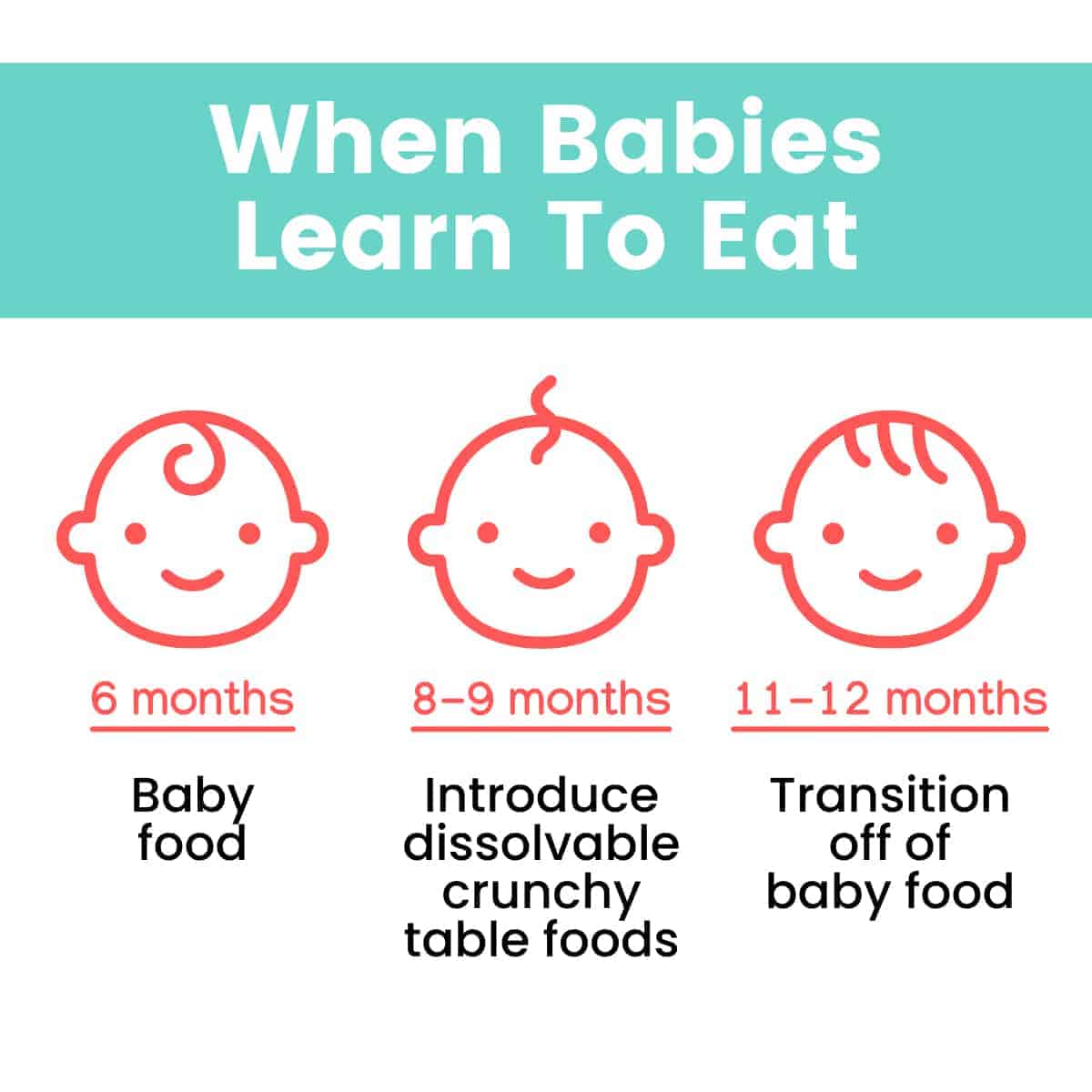
Generally speaking, a good time to start introducing table foods for most babies is around 8-9 months. However, it may be later for your child, especially if they were a preemie. You will know they aren’t quite ready if they refuse, gag, or cough a lot when you try.
That’s okay, don’t be discouraged, this just means you will need to take it slower and consistently offer safe foods they won’t choke on.
If you’re nervous about how to handle gagging or your baby is gagging a lot on foods, check out Everything You Need to Know About Baby Gagging.
For other babies, they may start eating table foods even earlier, sometimes at 7 months. As a feeding therapist, I can’t recommend starting table foods for baby too much earlier, but of course, it is your choice if you feel they are ready. It is likely that they will be mostly swallowing (not chewing) most of the food though.
One critical word of caution is to NOT wait too long to start transitioning to table foods. Babies will instinctively chew from 7-8 months to around 11 months old, which means the transition will come easier.
Waiting past 10 months, unless your child has developmental delays, a diagnosis, swallowing difficulties, or was born prematurely, can make transitioning to table foods even harder when they’re a toddler. See the chart above as a quick reference.
Step #1: Make Sure Baby is Ready for Table Foods
Some signs your baby is ready for this transition are:
- Looking at or grabbing your food
- Making a chewing motion with their mouth when they watch you eat
- Picking up small objects
- Are 8-9 months old. See 9 Month Old Baby Food + Table Food Ideas.
- Brings hands to mouth
- Can sit safely with or without support
Remember, you want to start this by 10 months even if you aren’t seeing some of these signs, as long as they don’t have any of the reasons listed in the previous section to delay the start of table foods.
A week or two before you begin to introduce solids, start to thicken their baby food. Thicker foods require more movement of the tongue and muscles in the mouth, which helps lay a good foundation for moving a solid piece of food around in their mouth.
If you’re making your own baby food (get the DIY here), then add less water or liquid when pureeing. Use stage 2 baby food if you’re buying premade baby food.
Beware that some stage 3 type foods are great because they are thicker, but many of the jarred varieties have whole pieces of food mixed in with the puree, don’t go there – yet. That is putting the cart before the horse.
For now, it’s crucial to stick with smooth purees, gradually increasing their thickness, as your baby tolerates it. NO CHUNKS.
The mixed in chunks can cause gagging and a negative experience. It’s actually harder for babies to eat than table foods. Babies that eat chunks in their baby food well are just swallowing it all without chewing.
I’d also recommend increasing the thickness of store bought baby food by adding cereal (this is one of my favorites) or freshly pureed foods into jarred baby foods.
Step #2: Demonstrating
Once you start thickening their baby food, it would also be great to start eating at the same time you feed your baby, if you aren’t already. Your baby will watch what you do and learn a lot from it.
When you see that you have their attention, begin to dramatically chew for them, even with your mouth open. Show them how you put a small piece of food into your mouth using your hand.
It may take finding the right moment to get their attention, but this will help pique their interest in table foods, as well as teach them what they should do when you hold that piece of food up to them for the first time.
The Best First Table Food for Babies
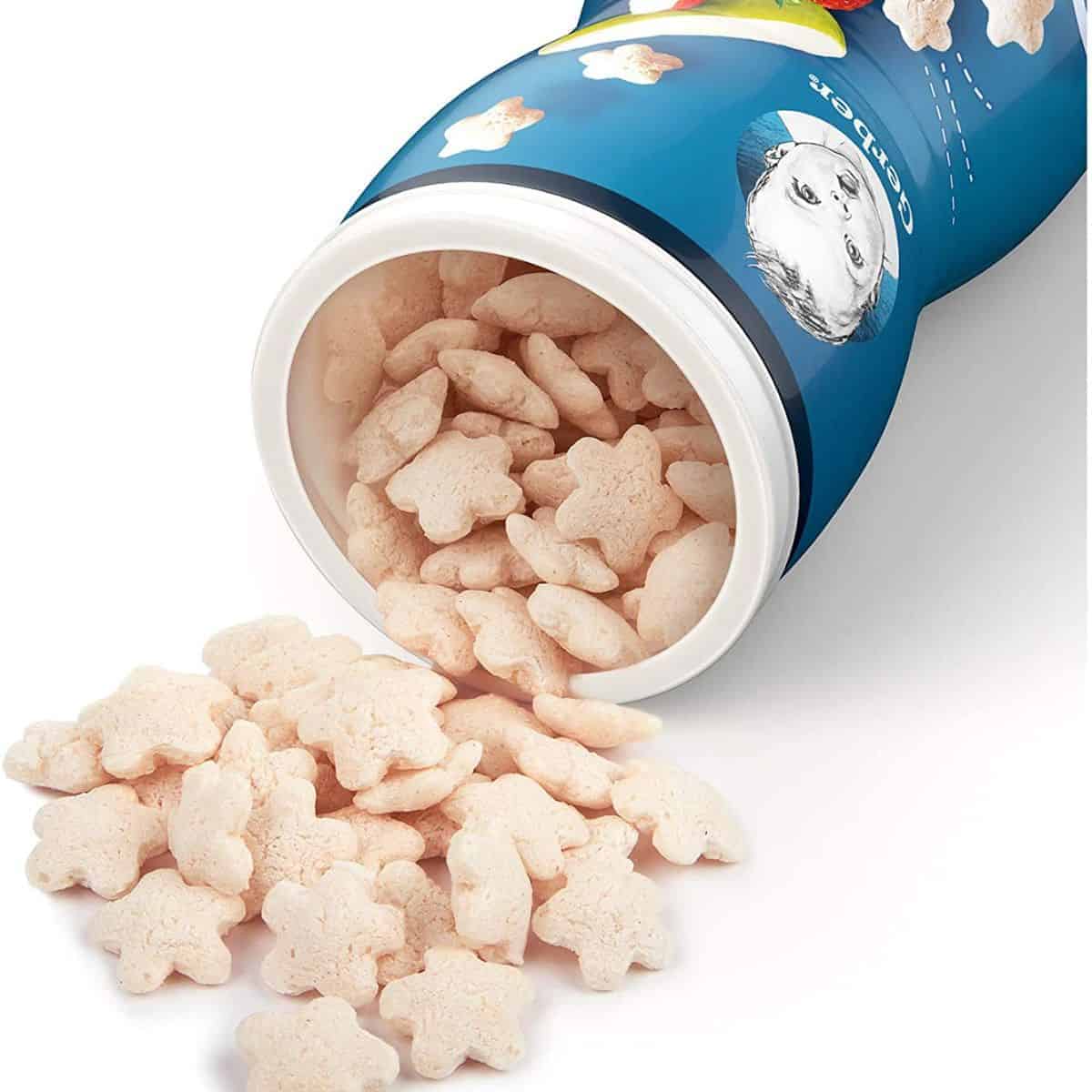
Before we move on, you need to know what table food to offer your baby. A great place to start, and the best choice for a lot of babies’ first table food is a meltable puff.
I’ve used Gerber puffs many times, but there are so many brands, just test whatever type of puff you buy by letting it sit in your mouth and seeing how quickly it dissolves.
The dissolving factor is important because if your baby doesn’t chew the puff, it will dissolve in their saliva.
Puffs are perfect because they are hard and crunchy initially, which helps babies realize there is something in their mouth. That crunchy texture also helps them find it and maneuver it around in their mouth.
It may seem to make sense to start with a soft table food like eggs or banana. Not bad logic, but because those foods are so soft, babies have a hard time feeling exactly where it is in their mouth.
For some babies, this means they will refuse table foods and for others, it means they aren’t chewing and just swallowing.
The wonderful thing about puffs is that they dissolve in saliva in just a few seconds. So, if your baby doesn’t chew while they are learning to eat and they swallow, they aren’t going to choke on it. That is peace of mind.
Puffs are also great because they can be broken into really small pieces for those first attempts, if needed. And, babies can pick them up easily! Read more in when can babies eat cheerios and puffs? (Cheerios are much later, they don’t dissolve)
Step #3: Introducing Table Foods to Your Baby
The very first time you give your baby an actual table food, you’ll want to try and pick a time with little distractions so that you can give them your full attention.
Make sure they are seated in their high chair because this keeps them in a safe position and will help prevent choking. Read about how to make sure your baby is seated safely for eating.
Place the table food on their tray and allow them to touch and explore it for a few minutes. Some babies will pick it up and put it right into their mouth, depending on their age. While that is certainly ideal, your baby may need some more help.
If they aren’t putting the table food into their mouth, demonstrate picking it up and putting it into your mouth. Then, pick up a piece and put it into their mouth, right where their molars will be. Or, if they’re holding the food, gently guide their hand towards their mouth for them as you smile reassuringly.
If they munch up and down and swallow, you can offer more bites.
However, on the first attempt, some babies cough or gag. Other babies will spit it out. Be encouraging, peaceful (they will sense your stress, fake it if you have to), and know when to call it quits. Often, it may take a few meals over a few days before babies get the hang of it.
If your baby turns their head or pushes your arm away when you try to put the food in their mouth, then respect that and don’t force it. They may need some more exploration with the food first.
Step #4: Transitioning Baby to Table Foods
Continue to offer puffs for a few days to a week at every meal alongside their pureed food, until you can see them munching up and down with their jaw most of the time.
Ideally, they should be feeding themselves the puffs, too, but don’t let that be a deal breaker on moving forward. You can help them put the puffs in their mouth as long as they’re willingly opening their mouth.
Puffs have next to no calories. They are great to use when they are just starting on table foods, but as you pull away from baby food they don’t offer enough to fill their little bellies.
Find baby feeding schedules for 8, 9, and 10 month olds here and 11-14 months here.
Once your baby is enjoying puffs, you’ll want to try small pieces of other foods that dissolve really quickly. Some examples are: Town House Crackers (not Ritz, this texture actually requires more chewing), Graham Crackers, Teething Wafers, Baby Cheese Puffs, rice husks, and other stage 1 table foods you find in the baby aisle at the grocery store.
Trader Joe’s Social crackers are another option if you live by one.
Encourage your baby to feed themselves these finger foods, but certainly give help as needed. If they are eating these types of food well, it is time to move onto some softer foods that require a little more chewing, which we will address here in a minute.
If you aren’t sure if finger food is safe, do a taste test yourself. How quickly does it dissolve compared to a puff? How much do you need to chew it?
How do you know your child is eating foods well and ready to move on? When they are chewing it with little to no coughing, choking, or gagging, and swallowing easily (not hard gulps), consistently, for a week or two.
At this point you can also try pairing crackers and other crunchy foods with spreads like jelly, hummus, and cream cheese to maximize exposure to table foods and different textures.
Spread right on the cracker or show them how to dip it into a glob on their tray. Then, start giving them these foods first, before the baby food, at a meal and allow them to eat as much as they want or will.
Step #5: Getting Your Baby or Toddler to Only Eat Table Food
As your child eats a variety of crunchy but melt-able foods well, then you can start with soft foods like bananas, avocado, noodles, scrambled eggs, boiled potatoes, muffins, deli meat, cheese, breads, and overly cooked veggies in a cube shape.
You can also try these cubed “jellies” or little frittatas, that are perfect for this stage too. It may take a few days or weeks before you’re ready to move onto these soft foods.
I have been mostly focusing on actual cubed food that babies can easily feed themselves, but as they eat those softer foods and the spreads well, you can start to slowly experiment with mixed textures like soups and casseroles.
Again, you will want to keep this slow, maybe starting off with macaroni and cheese, and then moving to spaghetti and meatballs and then chicken noodle soup. The latter has a lot more changes in consistency in one bite of food.
You can give baby a couple of pieces on the tray of these types of food, but will probably be mostly feeding by spoon.
When your baby is eating several cracker like foods and several soft foods, you can pull back from giving as much baby food and perhaps skip the baby food at some meals.
As they eat more and more of the table foods, you’ll serve less and less baby food, skipping it more and more until you no longer need it.
If you feel they haven’t eaten enough of the actual table food then give them some of the baby food. Keep in mind that babies need to eat actually very little and a tablespoon or two of finger foods may be plenty for them.
If you’re nervous about how much your baby should be eating, check out toddler portion sizes, the info is great for babies too!
And if it feels like you’re lacking inspiration for what to serve, see my Mega List of Table Foods.
Important Tips for Transitioning Baby to Table Foods Easily
- Once you begin introducing table foods, offer one table food at each meal. Then, slowly increase the variety of foods they are eating as they are managing more foods.
- Continue to steadily increase the thickness of baby foods as you progress with table foods. If you aren’t making your own baby foods, try pureeing what you are eating for dinner or mix this into the jarred baby food. This will help get your child used to more textures and tastes. I love using a magic bullet for this!
- Carefully monitor all new foods. Some coughing and an occasional gag is normal. If you are seeing this frequently, the texture you are giving them may be too difficult for them. Wait a week or so before introducing it again and then proceed slowly. Discuss persistent gagging and choking with your doctor.
The Big Picture: Introducing Table Foods to Baby Cheat Sheet
Let’s sum up everything we’ve talked about in transitioning your baby from purees to finger foods and solid foods with a list that you can use as a quick guide.
- Give baby puffs as their very first table food.
- Give other food that have a crunch but melt easily, like cheese curls and graham crackers.
- Give crunchy/meltable foods layered with another texture like spread, dip, etc.
- Give soft foods that you’ve cut into a small cube.
- Give soft foods with irregular shapes like scrambled eggs, noodles, and ground meat crumbles.
- Give crunchy foods that don’t melt as quickly like cheerios, toast (add toppings like hummus, avocado, etc.)
- Give mixed foods like casseroles and soups (start off with foods that don’t have a lot of chunks in theme and monitor closely)
Important Tips for Transitioning Baby to Table Foods Easily
- Once you begin introducing table foods, offer one table food at each meal. Then, slowly increase the variety of foods they are eating as they are managing more foods.
- Continue to steadily increase the thickness of baby foods as you progress with table foods. If you aren’t making your own baby foods, try pureeing what you are eating for dinner or mix this into the jarred baby food. This will help get your child used to more textures and tastes. I love using a magic bullet for this!
- Hot dogs, grapes, marshmallows, large dollops of nut-butters, nuts, lettuce, popcorn, hard candy are all potential choking hazards. Hot dogs, grapes, and marshmallows can be cut into small pieces. Spread nut-butters thinly on foods. Food larger than a pea could get lodged in the airway.
- Carefully monitor all new foods. Some coughing and an occasional gag is normal. If you are seeing this frequently, the texture you are giving them may be too difficult for them. Wait a week or so before introducing it again and then proceed slowly. Discuss persistent gagging and choking with your doctor.
- Remember to ONLY move onto the next step once your baby is safely and consistently eating the previous step for a few days to a week or so, depending on your comfort level and the time it takes your baby to learn, which varies widely.
Help, My Baby or Toddler Won’t Eat Table Food!
Some children have a hard time moving onto table foods. Often these babies were pros at baby food, but turn their noses up and refuse many or all table foods.
It’s not uncommon for parents to even experience situations where their 10, 11-month, and even 1-year-olds and toddlers won’t eat solids.
As we discussed in the first section of this article, in this case, it’s critical to consider that there’s an underlying difficulty affecting your child’s ability and willingness to eat.
To figure out what you can do to start helping your baby, I highly recommend our free table food workshop. You’ll learn how to make some powerful but easy changes to what and how you feed them.
If you continue to struggle with moving forward with this process, consider feeding therapy. If you are in the states you may qualify for free help from Early Intervention.
Free Printable: Learn How to Eat Table Foods Cheat Sheet!!
Want to have all these steps in your hands so you can reference them in a heartbeat? We’ve got you covered you’ll find all the steps for transitioning your baby or toddler to table foods in this handy free printable:
Click here to get the free Learn How to Eat Table Foods Cheat Sheet
More on Transitioning Baby to Table Foods from Your Kid’s Table
The Ultimate List of Baby/Toddler Meal Ideas
The Best High Calorie Foods for Babies
Getting Picky Eaters to Eat New Foods
A Weekly Meal Plan of Table Foods For Your Baby or Toddler: So You Can Save Your Sanity
Alisha Grogan is a licensed occupational therapist and founder of Your Kid’s Table. She has over 19 years experience with expertise in sensory processing and feeding development in babies, toddlers, and children. Alisha also has 3 boys of her own at home. Learn more about her here.
I just want to thank you SO MUCH for this guide, it’s been such a lifesaver. We wanted to take it slowly with purees and the transition to table foods, and so many guides out there right now are focused on baby led weaning from the start, which was not the right fit for our baby and family. We followed your stages with patience and the timing you suggested and have had such good luck so far. Thank you for the detailed steps and specific recommendations (like knowing to get Town House crackers instead of Ritz!) and just all the free, helpful content on your site in general
Woohoo! SO glad to hear things are going in a positive direction. Thanks for this feedback! I will make sure it is passed on to Alisha 🙂
Best,
Laura
Your Kid’s Table team member
Thank you for the topic, I have a 13 months old daughter, she is breastfeeding, we try to give her Baby’s Food since she was 6 moths old, she ate only for 1 Month, than she refused her mouth to open, she wants only the Breast, untill now she refuses to eat, only want the Breast. I will be thankful for any idea
Thank you
Hi Mazen, I’d definitely keep working on it, using as much exposure for play and attempts to eat as possible. Check out this article on when your baby won’t eat solids and see if it helps.
Best,
Laura
Your Kid’s Table team member
I have a 3yr old & all he eats is baby jar food & apple sauce. he will only drink milk from a baby bottle & will chew on bacon bits for awhile and then spit out also he doesnt like to eat by himself ….we are waiting him to start feeding/speech therapy in 2months (ive been waiting for this appt since march of this year 🙁 )
Hi Liyah, this can be very stressful, and I’m happy to hear you are on a list for feeding therapy. Wait lists can be crazy. Have you had any luck adding any variation to the purees, like chunks instead of completed smooth? I know you have a bit longer to wait, but I wanted to make sure you saw the follow up post to this article here.
Best,
Laura
Your Kid’s Table team member
Hi. My son is 17 months old and refuses to eat table food. He is stuck on eating jar purée baby food. If I give him puffs or even canned vegetables like I was told by his doctor he will take a bite then spit it out. He won’t chew it up or swallow it. He gags as soon as he puts it in his mouth. I’ve tried all kinds of table food and he still won’t eat them. I don’t know what else to do. Any advice will be greatly appreciated! He eats puréed baby food just fine but will not eat any table foods. He won’t eat anything unless it’s jar baby food.
Hi Samantha! Thanks for reaching out! First, we always recommend discussing this with your pediatrician, who will make sure your son is otherwise healthy, at a good weight, and doesn’t have any eating difficulties (swallowing, GI, etc). Next, start practicing some oral motor exercises and sensory activities to help ease him into being more comfortable with textures other than purées. Sensory bins, food play, and oral motor exercises can really help with this! Allow him to touch/feel/play with his food. Use a toothbrush to brush the insides of his mouth between meals. Sip from straws, blow raspberries, and make silly faces. All of these exercises can help strengthen his oral muscles and desensitize his gag reflux and sensory sensitivities. Lastly, we have a free table foods workshop that can help even further! Save your seat here!
Best,
Kalyn
Hi my daughter is 21 months old and she already got all her teeth.Her doctor told me to start giving her table food but when i first tried it she is crying a lot and doesn’t want to eat, she spit it out, gag and cough but when i gave her the same food into pureed she eat it but still didn’t finish it.Am getting problem with her on that process plz help me.
Hi Madeeha! Thanks for reaching out! Definitely consult with your pediatrician, due to her age. Your doctor can potentially refer you to a feeding therapist that can offer some hands on help. In the meantime, try using some sensory activities and oral motor exercises to help with the sensory sensitivities and oral muscles that work to chew/swallow. With food, the main thing will be to keep offering without any force or pressure. Allow her to touch/feel/play with her food and different textures. For more in-depth tips, definitely check out our free table food workshop— save your seat here!
Best,
Kalyn
My son was put on solids at 4 months due to his reflux. The doctors (his pediatrician and his pediatric GI doc) thought that it might help the reflux. At 8 months he still was not really eating purees and seems to be going backwards. I realized that most of what I thought he was eating was actually coming back out of his mouth. As he got old enough to keep it in his mouth, he started gagging, coughing and choking. My doctor and the OT whose blog he wanted to me read both were saying that gagging is healthy and never leads to choking. They were wrong about that. Once gagging became predictable, my son would cough while gagging to get the food out and gagging > coughing > choking became the chain of events every single time we tried to feed him purees because he would aspirate while coughing. When my doctor was still giving me this counterproductively positive advise, like “you got this, mama. It’s all fine” at 11 months old I realized that he wasn’t hearing me. I got myself an OT. Being in a big busy city, that meant the OT and I couldn’t connect until he was already 1 year old, but she immediately confirmed that he was lacking the oral-motor skills needed to lateralize his tongue and the food was just hanging out in his mouth until he either accidentally swallowed it or sputtered it out. She also identified some sensory issues. She noticed that he has trouble modulating his muscles in the way he smiles like his face will break and his hands splay out so much they almost bend backwards. She says he has some proprioceptive delays. And I see it now too. But it all becomes a big mess that is hard to untangle. Is it that the proprioceptive delays has led to an oral motor delay, or vice versa, Or has his reflux kicked this whole thing off and the sensory issues made it worse? He has other sensory issues. He notices very small noises in a noisy environment and is obsessed with ringing bells. He doesn’t like food on his hands, but he also doesn’t like his hands and face washed off. He loves hanging upside down. Diaper changes are a nightmare, which might be sensory, but I also suspect the reflux is active again and he doesn’t like laying down. Behavioral habits might be in play after months of having bad experiences. He gags when he even looks at certain foods or sometimes when he gets them on his hands. He is a giant one year old that is really difficult to keep well-fed because almost all of what he is eating is formula – hard to obtain, HA formula. It’s been a month of intensive treatment with the OT and I’m praying something gives. Deep pressure gum massage is one Rx, but the OT is better at it than I am. We’ve been working with him to lateralize his tongue. Getting him to chew teething crackers on the side of his mouth, which sometimes he will do now. We’ve been using a mini-probe from Ark therapeutics dipped in ice water to help him swallow the bit of crackers he pockets in his cheeks by placing it on his “molars” or gums where they’d be and making his tongue move. Drinking water has been achieved by using a cup with the nose cut-out, keeping his tongue inside his mouth by controller the floor of the cup and gently pressing under his chin. He will not let a spoon in his mouth but he will take water on a spoon. He really wants to feed other people. He likes shoveling food around, but becomes tantrummy if anyone tries to take control, and get it into his mouth. Poor thing. But sometimes, in a restaurant, he will surprise us all and steal food from our plate and plop it in his mouth. I just want to see him happy and eating. I think it’s also important to mention that he had a tongue tie and I had stopped listening to bad advise and got it released. Who knows how much it was an issue, but I have to tackle each factor so we can drill down to root causes. My work has recalled me and I’m unable to put him in daycare. The treatment is absolutely bankrupting me. But it is my top priority. One last word about doctors. They use proxy measures, and if your child is not underweight, they just won’t ever be concerned, because they don’t see you struggling to keep that baby fed or still doing night feedings at 3am. And even though he knows and likes my OT and has worked with her professionally before, I think a core problem is that he doesn’t believe in sensory issues. He told me even after I bypassed him and got treatment that I should take her advise critically because he has never *not* seen a child come back from OT without a diagnosis. In other words, every person he didn’t recommend go to OT, went anyway and had their problem confirmed.
Hey Jen,
Thanks for sharing with us, so sorry for all that you are going through. It is so hard when professionals aren’t seeing the whole picture and providing advice that isn’t helpful, but we do see it all the time. It is hard to tell which came first, but it does sound like you’ve recognized where the struggle lies in with oral motor and sensory difficulties (both common in picky eating). It does sound like the OT is providing you with lots of great oral motor activities to help move him along, it will take some time as feeding does. I would make sure they are also providing you with some sensory strategies as well to work on that side of things! If you need any resources from us, feel free to let us know. We are so glad you followed your gut and got connected with an OT!
Best,
Desiree
Your Kids Table Team Member
What is an OT please ?
Hi Connie! An OT is an Occupational Therapist! OTs help build/address gross/fine motor skills, visual skills, sensory processing, cognition/behaviors, self-care skills including feeding, and age-appropriate developmental play skills. Let us know if you have any additional questions!
Best,
Kalyn
My daughter is 2 years old. She is a picky eater. If the food is not blended she gags and cry. It is my fault that she is no eating table food at this age. She doesn’t eat meat or pasta, only pureed food. I need help and tips of what I need to do next !
Hi Micaela! Thanks for reaching out! Please don’t blame yourself, you are definitely not alone and we are here to help! First, we always recommend discussing this with your pediatrician, who will make sure your daughter is otherwise healthy, at a good weight, and doesn’t have any eating difficulties (swallowing, GI, etc). Next, start practicing some oral motor exercises and sensory activities to help ease her into being more comfortable with textures other than purées. Sensory bins, food play, and oral motor exercises can really help with this! Allow her to touch/feel/play with her food. Use a toothbrush to brush the insides of her mouth between meals. Sip from straws, blow raspberries, and make silly faces. All of these exercises can help strengthen her oral muscles and desensitize her gag reflux and sensory sensitivities. Lastly, we have a free table foods workshop that can help even further! Save your seat here!
Best,
Kalyn
Do you have a bigger list of foods to offer, in order? Your post helped me realize I was giving my child foods that that were difficult for her to start with (but that I thought were easy). I’m already doing graham crackers, puffs and toast but she’s not ready for avocados and bananas. What else can I try now? Is love more guidance. Thanks!!
Hi Christie! Thanks for reaching out! We do have a Mega List of Table Foods to try. But for more step-by-step guidance, I’d definitely recommend our free Table Food Workshop. Save your seat here!
Best,
Kalyn
My toddler is 16 months and still won’t eat table food. He wouldn’t even attempt purées until about months. He is very stubborn. He is now interested in table food and he will suck on it but has no idea what to do with it. What should I try? I don’t know what else to do.
Hi Jessica! Thanks for reaching out! It’s great that he’s now showing interest in table food! Since he’s stuck on purées and just sucking on table foods, he may need help with chewing/swallowing. Meltable puffs are perfect for practicing chewing and adjusting to a crunchy texture. Also try practicing with some sensory and oral motor exercises by allowing him to touch/feel/play with his food and using a toothbrush to brush the insides of his mouth. Other oral motor exercises include making silly faces, blowing bubbles, sipping from straws, and licking lollipops/popsicles. These exercises will help strengthen his oral muscles, which are what he uses to chew/swallow his food. Along with that, we encourage promoting a no-pressure environment, where he chooses if and how much he eats, without any forcing. We have more tips for chewing in our post here! Hope that helps!
Best,
Kalyn
Hi. My son is making 3 years old this may. But he has totally failed to adjust to table foods. So am forced to keep mashing up his food. And I have to keep feeding him otherwise he will not eat. If its something he likes, he will feed him self. How do I get him to start table food. Am really worried. He also like more of the sweet than salty foods
He doesn’t chew and if he isn’t interested in the food, he will not swallow it.
Kindly help.
Hi Kevina! Thanks for reaching out! First, here is our blog post with tips on teaching your child how to feed themself. If he has difficulty chewing and swallowing, definitely consult your pediatrician as well. Second, check out our free table food workshop, which helps provide in-depth tips for transitioning from purees to solid foods! Hope this helps!
Best,
Kalyn
I am desperate for help. I have a 13 month old daughter who has 6 teeth (4 on top, 2 on the bottom) and she will not eat solid foods. I have tried stage 3 baby food and she gags, then refuses. I have tried scrambled eggs, which usually results in one or two bites, then refusal. She is still drinking formula (mixed in with a little bit of milk, trying to get her on milk) which usually results into her not drinking the bottle. I have talked to her doctor and that was her suggestion. Now she isn’t sleeping well and I feel it’s from being hungry. I’ve even gone back to just formula, she will occasionally finish the bottle, when hungry enough. Refuses a sippy cup. I have been trying this since she was 6 months old. Now we are at the point where she needs to be using a sippy, drinking milk and eating solids.
Hey Kayla,
So glad that you reached out! We know how difficult this transition can be on everyone! First, I would stop trying with the stage 3 food (some kids do well with it, but gagging is also common because they have not yet learned how to chew the hunks of food that in with the puree that they typically just swallow). The next step I’d be working on is meltable foods (this is the first step in transitioning to table foods). You can learn more about how to make that transition in our free workshop! Save your seat here! As for drinking, I’d try to work on drinking from a straw cup this can be fun for kids as well as utilizing a character favorite cup can be helpful. But learn more about straw drinking here!
Best,
Desiree
Thank you for the article! I feel less crazy! My son is 14 months and will munch on crunchy foods like goldfish, Gerber cheese puffs and crackers but out right refuses solid food after a few bites. He can use a spoon but loses interest pretty quickly. Eggs, carrots, potatoes, peas, pasta all get a nibble or two but then he just wants his formula. I have some luck with Yogurt pouches but no other pouches. He used straws regularly. He has strained bowel movements and the only pediatrician advice is give him fruit and veggies but he refuses. Any thoughts on ways to convince him?
Hi Drew! You are definitely not crazy! We’re here to help 🙂
It could be that he just prefers milk and is filling up on milk, therefore only eating small amounts of his food. Try gradually decreasing his bottle feedings and replacing one by one with a meal or snack. We have a sample schedule you can check out here! If that doesn’t work, we do have a free table food workshop that helps guide you through transitioning to table foods more in-depth. Save your seat here!
Best,
Kalyn
Hello! We recently started introducing finger foods to my 8 month old. He had puffs and teeth in crackers for a few weeks before (since 7 months). The first week and a half of finger foods he did so well and loved everything and couldn’t get enough. Now on the second week all of a sudden he’s refusing. So I’ll do thicker purée with baby oatmeal and yogurt and still have some ginger food. By the end he’ll take a few pieces but not nearly as much as he was. For dinner, he seems to still be into it. Is this ok? Not sure how to adjust since he was loving it
Hey Janine,
Thanks for reaching out! It sounds like you’re on the right track. Even though he have just started refusing the finger foods, keep rotating them with the purees he is eating, especially at dinner time if he tends to eat more at that time. We recommend using a no pressure approach. You can also get some more info on transitioning to table foods through our free workshop. You can save your seat HERE.
Best,
Andrea
My child is 16 months old and still on the Breast and still on puréed baby food. He chokes sometimes on the dissolvable puffs please help lol I don’t know what to do.
Hey Amber!
Thanks for reaching out! You’re not alone! So many other toddlers have these same challenges. I’d suggest watching our free table foods workshop. It’s geared towards toddlers with these same struggles. You can save your seat HERE. Please reach out with any questions!
Best,
Andrea
Hello!
Can you please help. My 19 month old doesn’t t want to eat solids. I have tried everything. She has teeth and eats a slice of pizza without a problem but besides that she doesn’t like eating anything else. She doesn’t even likes fruits that are naturally sweet. I tried making her pancakes and she spits it out. I don’t know what else to do. Please help me!!!
Hi Patricia! So sorry to hear that your daughter is having a hard time with eating solids. We really encourage a no-pressure environment, where you offer her a variety of foods, but don’t force or pressure her to eat it. Since she’s rejecting certain foods, she may need help with her sensory/oral motor skills. Try using a toothbrush to brush the insides of her mouth- this will help desensitize her gag reflux and strengthen her oral muscles. She may also need help adjusting to different food textures. Try putting the food on her tray and allow her to use his hands to touch, feel, and feed herself. It may be messy, but this is perfect for her sensory and motor skills! You can even try pre-loading a spoon and setting it on her tray for her to practice picking up the spoon and bringing it to her mouth to eat. You might also benefit from our free workshop centered around table foods! Click here to save your seat!
Best,
Kalyn
Hi! How big do I cut the cube when I’m first offering soft cubbed foods? I’m dicing everything into teenie tiny pieces now and it’s hard for my son to put in his mouth (10 mo) because he doesn’t have a good pincer grip. Is a cube similar to the size of a dice or smaller? I don’t want him to choke!
Hey Jessie,
Yes, it should be big enough for most kiddos to be able to pick up! We always suggest sitting right nearby, especially when they’re first learning to eat new foods. Here’s a great article that gives some suggestions on how to help them feed themselves as well! Hope that helps!
Best,
Andrea
Hi!
I’ve been following the advice on this page for a few weeks now, and no luck! My son won’t even allow me to put the food in his mouth. He turns his head away and puts his hands in front of his face. He can pick it up easily, but he doesn’t want it anywhere near his mouth. It’s weird because he’ll chew on teether toys all day long. I’m not sure what I’m doing wrong… I’m so worried he’ll be a picky eater. He is a preemie. He’s 11 months actual and 9 months adjusted. Is he just not ready? It’s really beginning to get to me.
Hey Jenna,
We’re so glad that you’re here! He’s at the perfect age to be looking into this, so that’s great! Sometimes being a preemie can have an impact on feeding for sure. It might be a good time to start letting him pick up the food or use a spoon to feed himself. You can model this using an over exaggerated motion, feeding yourself. I’d also suggest our free table foods workshop. It is such a helpful resource and I think would be a great place for you to start. You can save your seat HERE.
Best,
Andrea
Hi. I think im having every issue you’re saying. My daughter started well on purée foods and pouches. Then on some finger foods. but she’s nearly a year now refusing food fed by us, any texture, refusing table foods. Only wants milk. I’ve taken her milk right down to make her hungry but it’s not working. She just wakes frequently at night now wanting milk. Literally at the end of my tether thinking what do I try next.
Hi Natalie! Thanks for reaching out! It’s great that she started out well with purées and some solids, she just might need more practice! Try letting her feed herself- allowing her to touch, feel, and pick up the food and place it in her mouth- even if it’s messy! You can also pre-load a spoon with some food and set it in front of her to let her pick up and feed herself. Model eating and chewing for her, using over-exaggerated motions as she watches you eat. If she needs help with chewing, try crunchy/meltable foods, such as baby puffs. These will help her get a better feel of the solid food in her mouth and teach her to bite down on them. You can learn more about all of this and more in our free table foods workshop! Save your seat here!
Best,
Kalyn
Hi. When we started weaning I spoon fed rather than baby led, but did give bits on the side for him to pick up and eat himself. He was never really interested in eating this and just threw it on the floor.
We are now 16 months and at the stage where he still doesn’t really want to chew anything, (he still wants food mashed / easy to swallow) and he will not try any new or different foods. He very occasionally will put it in his mouth, but then just spits it out, he won’t even take a bite. He is having the same 3 meals everyday as that’s all he will eat.
I spoke to a dietician recently, as he is allergic to egg, and she said to keep offering the new foods along with the old foods and eventually he will eat the new. I have been doing this everyday for a couple of months now (every lunch and every dinner) and he will still not touch any new foods. He is also not bothered if I give him food from my plate.
He currently has porridge with squashed blueberries for breakfast, cheese toastie and a yogurt at lunch and mashed banana with weetabix for dinner (or after a huge battle mash potato, with carrots and peas). He is not having any meat, fish, different carbs etc.
He is also not saying any words at all – I’m wondering if it’s all related perhaps. Any advice please? I feel so stressed about it all!
Hey Harrison,
That sounds like it is really stressful for you! If you have concerns about his speech, we’d suggest bringing it up at his next doctors appointment. It does sound like he may be having trouble chewing. Using dissolvable solids like graham crackers or Gerber puffs can be a great teaching tool for chewing. Our free table foods workshop would be a great resource for you to check out. You can save your seat HERE.
Best,
Andrea
My baby is almost 13 months and I’ve been giving him puffs and small pieces of very soft foods for months and he still won’t actually chew anything. He just moves it around in his mouth like you would a hard candy then swallows. Sometimes just straight swallows with a big gulp. I eat with him and do the exaggerated chewing and tell him chew chew chew, but he still doesn’t. So I don’t feel comfortable moving forward with big pieces to where he could actually get a full meal. He does get tired of all the little pieces in about 10 min so he’s not eating a whole lot. Any ideas?
Hey Brittany!
Thanks for reaching out! Soft foods can more easily get lost in your little one’s mouth compared to crunchy foods. You might try dissolvable solids like gerber puffs or graham crackers. They offer a crunchy feedback, but dissolve quickly so they’re safer. We have an article about teaching how to chew, that would be helpful for you to check out!
Best,
Andrea
My 3rd child-nearly 3 old barely eats. He was diagnosed late on 10mths with diary and egg allergy (plus a couple of mils off a peanut allergy. We had tried lots of formulas and he ended up on neocate until about 6 mths ago. He lived on fruit, toast, pasta, vegan cheese etc + twice weekly peanut butter as advised. Now, since just over 2 the allergies disappeared and we tried oat milk-which he loves. As he’d not had much milk for 2 years we let him have lots at breakfast-big mistake. He refuses now any food at breakfast, everything he ate before he now also refuses (obviously bored of it). Lunchtime I’m lucky if he will eat a bit of apple, a bite of bread and 3/4 ritz! Maybe a smoothie. Evening comes and it’s chicken nuggets he demands. I give in out of desperation twice a week. (I know it’s bad) he doesn’t drink much water and by 5pm he’s asking for milk again! Please help as I’m at my wits end. (Luckily he’s somehow not underweight, but how long for worries me. Plus, I’m worried he will have tummy & digestion issues from practically being on a liquid diet!
Hi Laura,
That sounds like he had a tough start with food! That can be difficult for everyone. You might try to set out a plate with a small amount of breakfast foods and at least 1 food you know that he will eat (doesn’t matter if it is a breakfast-type food) and then a small glass of milk. Having him get in the habit of sitting at the table eating something (even if it’s something you aren’t crazy about) will get him in the habit and make it easier for you to expand foods long term. We also have a blog post about food jags. It gives some good information on how to expand foods! I hope that helps!
Best,
Andrea
Hello! My son is currently 10 months and even though he is the 3rd child, the process of transitioning to table foods and weaning off of formula soon still stresses me out. I am worried that I made major mistakes and I am hoping that you can provide guidance.
When he turned 10 months, I started stressing about how, in just 2 months, he will be off of formula and needs to be eating food well in order totake in enough nutrients. So I started introducing table food, which I think I shouldn’t have. He has been eating baby food for a few months and does well with it.( I did start thickening it recently too.) But here’s where I made the mistake- I never knew about the stage of starting with and mastering crunchy dissolving foods first. We give puffs and teething wafers and he does OK ,but I thought soft veggies and fruits would be easier, so I started offering little pieces this week and i feel like I shouldn’t have because he hasn’t mastered puffs and those things yet. I’m worried that I confused him and he wasn’t ready for what I gave. He’d would let me put a couple of pieces of the vegetables and fruits in his mouth but after 1 or 2 bites would refuse. Today and yesterday he wanted nothing to do with them, however he will touch and play with the food.
Can I rewind and go back to baby food and puffs/dissolving snacks? I really hope I didn’t make a negative impact by not properly following steps.
Hi Amanda! Thanks for reaching out! Try not to stress- you didn’t mess up! If you feel like he needs more practice with chewing crunchy textures, then go back to offering the meltable puffs until he masters that. However, if he chews fine and seems interested in other food, you can try to keep offering the soft cubed fruits/veggies. But try just placing them on his tray in front of him, dont force or pressure. Continue to allow him to touch/feel/play with it, and see if he naturally brings it to his mouth to eat. Feel free to still offer baby food and purées a few times per week, as its still good to have him be familiar with those textures as well. Hope that helps! If you feel like you need more support, check out our free table foods workshop here!
Best,
Kalyn
The Free printable Learn how to eat table food Cheat sheet is not available. It says there is a virus and on the downloadable page in my email is nothing but code and jibberish. Help, I am desperate to help my child eat.
Hey Jessica,
So sorry you are having trouble on your end. It sounds like your computer is blocking it. Email us at hello@yourkidstable.com and we can help get that to you!
Best,
Desiree
My baby eats finger foods and refused to eat anything off a spoon. But he eats only fruits and hasn’t developed a taste for anything other than that. Everything else he brings to his mouth, tries some and spits it out and then just plays around and throws it on the floor. Any help on what could be the reason and what I can do to change this is much appreciated. Thanks 🙂
What does it mean by cube shape? How do you cut veggies into cubes? Thanks!
Hey Cassandra,
A cube is a square shape on all sides. For vegetables it would just depend on what it was, but getting it as close to that shape as possible. This helps with them feeling all sides of it in their mouth so they have a better time recognizing where it is in their mouth to help with chewing.
Best,
Desiree
Hi! I am SO happy I found your blog! My son is 9 months old and still doesn’t seem super interested in food. I’m still breastfeeding about 8 times a day. I’m wondering if maybe that is why he doesn’t eat more than a few bites when we offer solids?
I make my own baby food at home and we started with super smooth purées at 6 months and he would NOT let us spoon feed him. He would grab the spoon and put it in his mouth. He uses it more and a teether I think and any food that he’s swallowing is not really on purpose. Every time the food enters his mouth he makes a funny face and then when he swallows he does a little sensory shutter. Is this a sign of a sensory issue?
I took a BLW course thinking that method would help him Since it seems like he just wants to feed himself. But the thought of giving big princes just made me too nervous. So now I offer chunkier purées as well as some very small pieces of the food that is in the purées during mealtime. I let him explore and play so mealtimes are about 45 min even though he might only actually be eating a teaspoon or so. We only do solids once (sometimes twice) a day so I know we should be doing it more often but it’s tough because he again just doesn’t seem very interested.
He has food allergies so we have been a little more careful (and slower) on introducing foods. I just get a little anxious every time he tries something new. I’m probably the reason he is behind as far as solids go. I know lots of babies his age who are eating 3 meals a day and way less breast milk. I’m hoping by the time he’s 1 he is on track and eating with me and my husband. This article gave me hope that it’s possible!
As per your advice, we started puffs today. He has a hard time getting them in his mouth (his pincer grasp isn’t very strong yet). He did however like the teethers and was gnawing on them but spit out the big pieces.
I’m sorry for all the questions! I appreciate you taking the time to read this long post. Any advice you have would be greatly appreciated! Thank you!!!
Hey Bree,
I love that you are reading and learning to figure out how to help your little one. I’d keep trying with the puffs, it may take a little, but is such a great tool for them to learn chewing! We do have a free workshop that walks you through transitioning to table foods that I think you will get some great information from. You can save your seat HERE
Best,
Desiree
I’m really glad I found this article. I started feeding my daughter the puffs a while ago… maybe 3 or 4 weeks ago. I’ve done toast but I haven’t tried anything else because I thought that meant she was ready for other foods too. Well, I’ve tried super soft carrots, zucchini, green beans, strawberries and blueberries and she will only touch it- maybe pick it up but as soon as she feels it she drops it. Is this a sign of a sensory issue? I’m not sure… sometimes if I put the softer foods to her mouth she might bite it, sometimes she won’t. Most of the time she will spit it out with rare occasion of swallowing. She appears to chew her puffs and toast, so I feel like she should be ready. Im just confused because she eats EVERY single jar food I’ve given her, so she is by no means a picky eater! Haha! Do you think she has sensory issues? Should I take her to the early learning coalition to be evaluated? She was also born 2 months early (33 weeks). Thank you!
Hey Stacy,
Sounds like you are doing a great job to figure it all out. It may be a sensory difficulty, I’d be working on playing with food and touching different foods during the play with no pressure to eat. We do have a free workshop that will help you can save your seat HERE
Best,
Desiree
I am trying to Move my daughter onto table foods. She is 9.5 months. She is eating some soft solids – grated cheese avo and is a pro at the puffs and baby num num crackers.
But nothing further. I am worried she will be fussy. Do I keep offering her finger foods and purée or should I only offer finger foods and then if she doesn’t eat she will just have bottle?
Thank you!!
Hey Stephanie,
So glad you reached out! We do recommend continuing with providing some purees (so that she can keep that consistency, even with yogurt, etc). And then providing some of the foods you are such as the meltable puffs and other foods she’s eating. We have a free workshop that will help walk you through introducing some other foods that may be helpful for you! You can save your seat here
Best,
Desiree
So thankful to have found this article. I’ve been beyond stressed out with transitioning my 11 month old son to eat finger foods. He had a hard enough time eating baby food solids. He had a sensitive gag reflex so he was always gagging and throwing up. He eventually got the hang of it but now finger foods is just worse. He can pick up pieces and feed himself. He’ll chew them but I have to be careful that he doesn’t put too many pieces in his mouth before he’s done chewing the previous piece. Just when I think he’s doing fine, he’ll start gagging horribly and there’s been times he seems to be choking. The pieces are very small so I don’t understand why. My anxiety has been at 100 because I’m scared of him choking so seeing him react that way is stressful. I just don’t know what I’m doing wrong and I have no one to really show me. People criticize me that I started him off too late but because of his sensitive gag reflex I couldn’t start him sooner. I’m having a really hard time and any help and advice is welcomed
Hey Tracy,
We get it, and know how hard the sensitive gag reflex can be. You are doing great and working hard to help your child learn to eat! I’d follow the steps with regard to food choices in the article to work your way up to harder foods. This Article will help you understand your child sensitive gag reflex and how to work with them to decrease it!
Best,
Desiree
Hi, my daughter is 13 months old and has no teeth. She regularly eats grains and dairy products. She loves anything with pasta (Mac and cheese, spaghetti, pasta salads, etc.) She eats oatmeal, Cheerios, baked goods (like croissants, muffins, donuts, etc.), Pancakes, eggs, PB &J sandwiches, rice, pieces of pizza, cheese, yogurt, and pancakes. I can’t get her to eat ANY vegetables, fruits or meat. She never has, she refused all of the baby jar food and went straight to table foods. She doesn’t get anything harder, like apple slices or celery sticks because she doesn’t have any teeth, but I think she would eat those things better because she has a texture aversion to the purees or something. Is it safe to give her apple slices without teeth? How can I get her to eat meat and veggies?
Hey Sara,
Thanks for reaching out! I think that part 2 of this article is helpful for you as it does talk about safely introducing of foods. Generally kids do not need teeth to chew foods, as they utilize their gums to bite and are very strong! I would make sure that you are modeling of biting chewing and try some food play with the foods she has not had yet to get her used to them!
Best,
Desiree
I’m happy to find out your website and find it interesting. I hope can find solution for my questions. My daughter is 22 months old. She dont self feed, not chewing the food properly, never sit at one place at meal time, not interested in food. I’m really frustrated now. Please help me where to start. I know i need lot of patience now as because she is old now to start but how can I do it now. I’m really confused to understand her. Her weight also low.
Thanks
Hi Archana,
So glad you are finding some good information on our site!! We understand how frustrating this can be! Since she is not interested in food, I’d start with some food play to see if you can increase interest. I’d recommend you to watch our free workshop to gain some tips on where to start and work through these difficulties. You can save your seat HERE
Best,
Desiree
My baby is 15 months old.she is eating only homemade pureed food.even if i give her mashed food she jus keeps spitting out..dis goes on for an hour..nothin is workin on her..i m very worried.
Hi Richa,
That sounds really frustrating! Sometimes the lumps and bumps in mashed food can make it difficult for some toddlers. Dissolvable solids (like baby puffs and graham crackers) can be a great step. They can be a little less overwhelming when just learning to chew. You might check out our Teaching Toddlers to Chew post for some more ideas!
Best,
Andrea
Hi there. My daughter is 8 months old and I feel like she is behind. I see other babies doing BLW and she can’t tolerate it. We have been moving to thicker purées and tried some puffs. At what point should I trial fork mashed foods?
Hey Jessica,
Every baby is different!! At 8 months you are doing great!! It’s okay that she can’t tolerate that, as there are other ways. I’d keep offering the puffs and other meltable foods as these are the easiest to manage and help to transition to other table foods. We do have a free workshop that will help with which foods to offer next/when. You can save your seat HERE
Best,
Desiree
I can’t seem to find part 2 of this post. Can you please share a link? Thank you!
Thats not a problem! Here is the link to Part Two. I hope that helps!
Best,
Andrea
Hello ,
My daughter is 13 months old .And she is not eating anythign other than baby food .She eats gerber puffs .She wants to eat some food but she gags and throw up after 2 or 3 bites and skip that meal .Is there any tips on improving her food habit . I do offer our food to her at every meal .Really worried .
Regards,
tina
Hey Tina,
So glad you reached out to us!! I can relate on how hard it is when your child is growing and having difficulties with eating foods!! It is really great that she is eating puffs as these are one of the first foods to use to transition from pureed foods! Trying to do some food play with foods outside of mealtimes to get her used to interacting and touching can be a great start! Sounds like you would also benefit from our free workshop that helps you set up meals and what foods to use next you can save your seat here.
Best,
Desiree
Hi, My daughter is 1 year old and eats only one type of gerber puffs and nothing else. She used to eat pureed food, mashed food, even table food but she was forced to finish her portions and force fed and distract fed till she stopped trusting us and doesnot open her mouth to try anything. How do I help her to eat table foods and gain her trust? She is surviving on just the puffs and pumped milk. I am not sure how long i can continue pumping as well.
Hi Chandrika,
I totally get it, when we just want our kids to eat, we will try anything! So glad that you reached out! We do have a free workshop on transitioning to table foods, that I think will provide you with some suggestions on how to set up mealtimes to help ease the pressure and have a more positive attitude towards meals with your daughter you can save your seat here. Also, I’d try to do some food play with your daughter outside of mealtimes so that she will start to engage with the food and touch the food, as this is the first stage in actually eating!! Hope this helps, Keep us posted!
Desiree
Hi! I have a one year old. He is not a picky eater he just eats very small amounts. He started to refuse spoon feeding and he wants to eat everything by himself. The problem is he eats less than 100gr of food per meal and when I was spoon feeding him it was 200gr. He is very skinny weighting 8,5kg and 80cm tall. He is now eating less than when he was 9 or 10 months old. In one day he eats 500gr of solid food + 300ml of formula Is that normal?Please help me
I totally get it! It is hard to feel like your child is eating enough when you are not feeding them, but it sounds like he is becoming more independent in his feeding skills which is great!! Kids do go through phases of eating more/less based on their development. Here is a post that I think may be a good resource for you!!
https://yourkidstable.com/toddlerpreschooler-portion-sizes/
Thanks, very helpful
My son did that too; our pediatrician recommended supplement each meal with some pediasure, it worked great and he eventually started to eat more food on his own
Hey Ju,
Yes, sometimes when there is a weight issue it is recommended by pediatrician to add in Pediasure to assist with weight. Some families just need to be careful that the child does not become dependent on just drinking their calories, because they find it easier than eating!! I am so happy that this was able to work for you and that your child began eating then on their own 🙂
Best,
Desiree
Hi,
Atlast I found ur site where I’m able to correlate my situation.One of my twin(my boy) 3 yrs doesn’t eat proper meal on table ..
He is used to smashed rice /porridge .he eats at times noodles a little, oats biscuits or some snacks depending on his mood but not our daily meal.
He when we feed his daily food like smashed rice he does all sorts of tantrums such that by the time we finish feeding him my BP mite ve been 300/190 🙂
I cannot categorize him that he doesn’t eat hard foods at all… bcoz he eats biscuits and little noodles or some crackers and also some dosa (Indian food)
When we make him sit In high chair and serve he plays with it ,throws food ..
But his twin(girl) atleasr eats when we sit next to her and spoon feed.
Plz suggest
Hey Varsha,
We can totally understand where you are coming from and know how hard it is! I’d first try to work on letting him try to play/touch some different textures of food, you can do this outside of mealtimes. This can help with them accepting the food later on and makes them more comfortable. We do also recommend removing all pressure from mealtimes as well. We have a free workshop that walks you through how to remove pressure as well as other strategies to work on eating with your child and it a perfect fit for what you are describing him doing! You can save your seat HERE
Best,
Desiree
I have a one year old and we’re struggling with table foods. She’ll eat purees off a spoon and she’ll eat puffs, but will spit out the mush instead of swallowing. She’ll put toast and a few other solids in her mouth, but won’t swallow, she spits everything out or gags. She was a preemie and born super small so I’m not surprised she’s struggling with the transition. We’re working with Early Intervention, but they are focusing on her motor skill delays and there is only so much time in each session so we don’t usually get to talk about feeding. I got her a baby toothbrush in hopes that brushing her teeth would help with the eating struggles, but she refuses to let me put it in her mouth. She clamps her mouth shut and jerks her head back and forth. When I give it to her for, hoping she’ll chew on it herself, she just drops it on the floor. Letting me put table food in the back of her mouth is also out of the question. Any suggestions for getting her to let me brush her teeth???
We understand this can definitely be a tricky time during this transition. You are doing a great job with getting early intervention started!! I would reach out to one of your therapists about getting some feeding therapy as well. They may be able to add a service to address this specifically. I’d check out this article below as it may have some helpful tips for you! One of them may be trying a vibrating toothbrush, some kids love this right away, while others may take awhile to warm up!
https://yourkidstable.com/sensory-processing-and-picky-eating/
I have a 10 mo old who is not progressing onto table food ‘well’. HE handles puffs and other crunchy foods well, but shows little interest in soft foods. BArely picks other foods off his tray and gags at least once a feeding if I give him something other than purées, thickened or not, and puffs. I don’t want him to start to associate food with gagging but also don’t want him to get stuck or develop texture aversions. Where is the line for evaluation and what can I do in the meantime??
Thanks for reaching out. I understand that this transition can be very hard and does take some time. I am SO glad that you are working with the proper textures and working your way up, starting with the meltables (puffs and crunchy foods) and then attempting the softer textures, this is GREAT!
I would try to do some play with those soft textures outside of mealtimes to see if he is okay with touching them and playing with them (this is the first step before eating them). Also, it may take a few tries before he is able to be able to actually eat these softer foods 🙂
As far as getting an evaluation, I would suggest always use your judgement or talk with your pediatrician. It never hurts to get an evaluation even just for suggestions. If you are in the US, you may find this article helpful on Early Intervention, yourkidstable.com/help-for-infants-and-toddlers-early/
Keep us posted and let us know if you have any other questions!
Hi!
I stumbled upon your post while researching toddler eating habits. My daughter isn’t 18 months old and eats a combination of table foods as well as baby food pouches because I don’t feel like she gets enough fruits and veggies otherwise. How can I help her to try different things when she refuses them? She enjoys crunchy snacks, French toast, anything potato related, frozen veggies, yogurt, and banana most of all. Any suggestions are appreciated. I’d love to get her to eat some type of protein but she refuses them all.
I totally understand where you are coming from, it is hard when you want to have your child eat a healthy diet and they are not cooperating!! I would try to have your child play with non preferred foods, so that she can get used to looking at them, touching them and accepting the feel of them, as this is one of the first things that they will need to do before they will eat those foods. I do have a free workshop, 3 Keys to Finally Turn Your Picky Eater Around, that I think you will find helpful on your journey!
Here is the link to get a seat yourkidstable.com/free
Hi! My almost 11 month old son is stuck at the eating soft foods. He will eat crackers and bananas..pancakes, toast.. waffles etc can but if you try to expand to like watermelon or blueberries he isn’t able to swallow them.how can i help expand his diet?
Keep expanding on foods your son already likes, add pureed fruit to the batters of pancakes and waffles. Also try adding a thin spread on top of those like cream cheese, jelly, crushed avocado, etc.
Hello! My almost 8 month old has been doing pretty well with the transition to table foods. She’s doing puffs, mum mums, and the Gerber little Crunchies. This week we also started some pieces of soft fruit and she seems to be enjoying it. I haven’t noticed much gagging but she does take a while to chew all of the food sometimes. Our main issue is that now she starts crying/whining when I give her purees. I usually start with the puree then give her the solids. But she just cries almost the whole time while eating purees, even though she keeps opening her mouth when I offer her the spoon. Other times she’ll push the spoon away and then I don’t force it. She usually stops crying when I give her the table solids. I have started thickening the purees but not by much; they’re maybe about the consistency of pudding. The only sensory response I notice is her arms are a bit “flaily” when she’s eating the purees. I even let her play with the puree on the tray and she has no problems touching it. Her seating position is as good as I can get it with the high chair in my budget. I’m a fellow OT (in hand therapy) but I took the SOS feeding course and I’m stumped! Any suggestions or ideas about what’s going on?
Well, she might be getting sick of purees, this happens in general and particularly for some kids that love table foods. I’d focus on that cube shape and use a Nuk brush to help her with the oral motor aspect!
My son is going to be 11 months on the 26th (it’s the 19th) I feel like I am failing as a parent because he is still on jarred baby food and formula. I try to give him other things and he spits it out and Spits it out. I’ve tried puffs. And he act a like he is choking I’ve tried real bananas just no luck
I totally understand Shelby. Have you tried the steps in the both of these posts yet?
What did you end up doing? I’m having the same problem with my 12 month old. It’s horrible
Hey Verna,
We do have a free workshop that walks you through transitioning from table foods and setting up positive mealtimes. You can save your seat here: yourkidstable.com/tablefood-workshop
Best,
Desiree
Hi Alisha, first off, love your page. Thank you for all the tips and guidance. I have a 7 months old that I am struggling to introduce solid to. I want to do the BLW as I have read the benefit. I am just concern as we are an Asian household and my mother is at home most of the time. We traditionally do puree and porridge. I have try giving him bananas and avocado so far and he seem interested to grab and squeeze and sometime interested to put it in his mouth, then gag. Sometimes he get a big piece and then I had to dig it out since he would throw up. I am just afraid I’d miss the window to train him for table food. Is it confusing to do both? I am just hoping he will eat anything. I’d print your list of table for to give so I will start there. Thank you again for all your tips.
No, not confusing at all! In fact, that’s what I recommend. You have a lot of time right now, but I love how proactive you’re being. The printable will be really helpful and we also have a free workshop this week that I think will help too: yourkidstable.com/tablefood-workshop
Hi! I have a toddler who can eat any food/texture of food before he turned 1. He had new seizures and after being confined to the hospital, he cannot eat anything but blender-ed food. anything with chunks goes right out of his mouth, worst, he would gag and throw up.
I will be taking him to a therapist to get this addressed as he is also a special case. I cannot even sit him down to eat. He still cannot communicate.
I’m so glad you’re getting some help Mai, it’s just what you need for a special case like this.
Hello! We just started giving my 9 month old table food as he was doing well with the thickened stage 2 purees and the Puffs and cheese curls. Now it seems he cant keep the food in his mouth. He did well with pancakes but struggles with things like noodles almost as if he’s not chewing them or doesn’t know to chew them since he’s not familiar with that specific texture? My LO is a preemie and is starting to show less and less interest in the bottle so I’m getting very nervous about his food intake since he’s not taking to table foods well. Help?
If he’s a preemie, with adjust age, he just might not be ready to chew yet. Developmentally, he’s right on track and doing the things he should. I’d keep trying more meltable crunchies and make sure you keep your doctor in the loop as well. Noodles are a really hard texture to manage actually. Think about doing the tooth brushing strategy I talk about in the post that can have a big impact:)
Hi Alisha, my bo is almost 3yrs and I still have a lot of problem with food. He had no problem as a baby eating finger food and trying different textures, but now he only eats some rice and spaghetti when he feels like, he won’t touch any vegetable in any form ( raw, different tyes of cooking it), he will never say no to toast or bread sticks, or any pastry ( filled with meat) , on the other hand he will not touch any meat by itself, he is not interested in fruits ( except bananas and grapes). We’ve tried putting a little food on his plate, tried letting him pick, even telling him he has to eat it or he won’t get anything else and he will get hungry, moody, cry a lot and still refuse to even try having a spoon. His twin sister and younger sister have no problem eating all kinds of food and trying new ones as well… Any suggestions?
It sounds like he’s got a good bit of picky eating stuff going on. This can get pretty complex, but there are some steps that I use to help kids like your son, first. I teach them in this free workshop, I think it will be really helpful for you!
First, I love this blog and I’m sooo grateful to have found this! I’m from the Burgh originally and love that you’re a Burgher. We are working with an OT for feeding for our 3 year old, and I have a 7 month old and trying to avoid some of the mistakes I made the first time around with baby food and transitions. You mentioned not going from stage 2 to stage 3 food “cart before the horse” so I plan to thicken her food with cereal this week and next. If you’re not planning to make your own food, though, when do I then introduce stage 3? Is it once they’ve successfully mastered puffs and seem ready? Or once I’ve thickened the puree with cereal for a few weeks and then try stage 3 alongside puffs? I’m a FT working mom and have to pack my baby’s food to send out, and don’t honestly have time to make baby food at this moment, but I want to send her with things that can help her make the transition without asking my childcare provider to provide chunky, real soft foods to “try” without me being there.
Hey Lauren! Yes, the Burgh is awesome and super cold right now, hope you’re somewhere warmer!!
You can move to thickening food around 8 months and do it slowly, they don’t necessarily need to be eating puffs yet. You can start now though if you want to experiment a bit. It’s totally fine to use store bought food, for real! Start trying it at home first and make sure she’s managing it really well.
At this age, I love using the whole raw carrots and celery too, did you see that in the post? That’s where I’d start now:) You’re doing great, love how proactive you’re being!
I think might have missed a section but I was wondering how small the toast and fruits supposed to be. I’m super nervous about giving my twins toast and crackers idk why but I am.
It’s is scary! There are two posts and you’ll find the links above, definitely look through the whole thing because there’s a progression of textures. Usually about the size of your pinky nail is good.
Hi Alisha,
I have a question about my 9-month old. I’ve been giving him puffs and Cheerios in addition to husband purées. He chews them very well but he refuses to feed himself. He’ll pick up and play with the food, but will not put them in his mouth. I’ve tried modeling and gently guiding his hand, but he just drops the food. Then he’ll get frustrated and cry if I don’t feed them to him myself. Am I doing something wrong? Any suggestions?
Thank you!
Not at all! I love that your trying, he’s at an age where he’s figuring this out. Check out this post on self feeding and let me know if you have more questions, it has detailed steps in it!
My baby (7 months) has fpies and cannot have grains (wheat, oat, rice). Is there an alternative we can try over puffs, etc? They all seem to have a least rice cereal as an ingredient.
If you can do corn, focus on cheese curls!
My 8 month old has started eating some table food and for a bit she would eat anything I put in front of her but now she is avoiding them and pinching her mouth closed. The only thing I can get her excited about eating is puffs and Graham crackers, and the occasional piece of fruit or veggie but that’s not often. Is this just a matter of consistency and patience or is there something more I should do?
It could just be a phase, try not to push too much and if it were me, for the next few days, I’d act like I didn’t care at all what she ate. Just put it down and eat along side her. If the problem gets worse or doesn’t improve, definitely talk to your doctor.
Hi, I just came across this post as i’m having trouble with helping my 10 month old transition to finger food. He doesn’t seem to be interested in the food i put in front of him and if he does pay attention to the food i put in front of him, he will grab it and smash it against the table. I’ve tried putting small pieces of solid food into his mouth which he will eat for the first 3 or 4 times anymore then he will spit it out and start crying. I just don’t know what to do, it gets very worrying and frustrating not to mention the fact that he favours his dad more also adds on to my stress levels :(. I hope he starts eating solids soon instead of puree.
Thanks for the post
Hi Lily, I actually just sent you an email about this as well.
Hi Alisha,
Im having the same problem with my 11 month old. She takes to purees better than finger foods. I do continue to offer her both but I notice she will just play with her food if placed in front of her. I feel like such a failure and don’t know what else to do.
Hi Alisha- I am also having a very similar issue to Lily. My son is 10mths old (going on 11mths on the 7th). We are struggling with the solids. I admit we may have started a little late in introducing the solids. We tried fruits first (pieces of ripe bananas, blueberries, grapes) and he rejected them all. Tried sweet potatoes and some squashes and nothing. Carrots were finally a hit. So I just did those for a few days and slowly mixed peas and squash and some rice. He was accepting it and then all of a sudden just wants nothing to do with them for the past week. He may accept a bit but takes 3 or 4 and then spits it all out and starts crying. He won’t self feed, just smashes the veggies and tosses them on the floor. He eats puffs, crunchies, and teething crackers really well (loves them!!), and those he does self feeds. I put him in his high chair and the minute he sees his bowl/spoon or me approaching him with food he starts getting frustrated (turning his head, rubbing his eyes/face, sticking fingers in his mouth). I’ve even tried waiting until he is really hungry and I still get the same results. The only way I can finally get him to accept food is by managing a spoon of baby puree in his mouth so that he gets the taste and knows I’m not trying to give him something he won’t like. I’m at a loss! Any suggestions?
You’ve done some really great things Adriana! I know it’s so hard!
It’s so good that he’s eating those crunchy meltable foods, I’d look back in these two posts for more of these foods and offer as many different types as possible. There’s also some suggestions on the next best foods. That’s the direction I would head in!
I’d definitely talk to your doc and think about scheduling a feeding eval. You can find out more in this post on feeding therapy. We also have a free handout with the steps you can sign up above in the post.
Hi 🙂 I was wondering if the Happy baby Happy puffs would work in replacing the Gerber puffs? Thanks.
Yes, They are the same meltable texture! I do think these can be a bit bigger, so if they have trouble at first you can break them in half and go from there!
Best,
Desiree
Hi! My daughter is 8 months old. We started to introduce purée at 6 months. I actually tried to switch to BLW and I don’t think she was ready as she frequently gagged. But she has always showed interest in foods. I just felt too anxious and I didn’t want her meals to be filled with anxiety. I quickly moved to more textured foods. I also have encouraged her to self feed with preloaded spoons or exploring food with her hands. She demonstrates great chewing skills for puffs and mum mum crackers but I am noticing with other solid foods, she has an audible gulp and I wonder if she is even chewing what is in her mouth. I have demonstrated exaggerated chewing for her and sometimes she will mimic it with foods and other times not. I just get nervous because of this audible gulp during the swallow. Any suggestions? Thank you!
Besides the crunchy foods that melt, I’d focus on soft foods that can be cut into a square like watermelon or zucchini bread. I’d also keep the pieces somewhat small, so that she doesn’t have to chew as much.
Hi, my son is almost 14 months old and is a very picky eater. Everything is pretty much a challenge except for gerber cereals and porridges. He cries most times when feeding him and I just feel like I’m failing him. He was born a preemie so that could be a reason why I have this difficulty but he’s also teething and his molars aren’t in as yet but he’s been suffering from a swollen gum for months now and gets very irritable. He hasn’t developed his pincher grasp but is able to pick up big items. I’m just wondering if there’s an underlying issue that’s causing all this or am I just not doing well by him.
Oh my gosh, this is not your fault! It’s more likely that something else is going on that he needs some help with. Did you see the free workshop, it ends today, but you can grab a seat here.
Hi,
My question is the following. When to introduce the crunchy meltable food like a teething biscuit? At the beginning of the meal?For instance my 14 month old son usually has cereals with fruits for breakfast. His lunch is usually vegetables or vegetables with meat. His dinner is polenta or semolina with fruits. So when should I give him the crunchy table food?
Hi Sanya, actually a teething biscuit is harder to chew, focus on small foods like puffs or cheese curls. I’d give them at the beginning of the meal and maybe have some throughout, so he’s able to eat as he wants to.
Hey! I have twins boys born at 32 weeks.
They turned one years old 2 weeks ago. One loves table food, baby food, whatever. The only one doesn’t eat it. Well, he eats the puffs, gerber cheetos, a couple of cheerios and yogurt. I tried all a variety types of fruits, meats, mashed potatoes, breads, vegetable and he put it in his mouth then spit it off. I’m going to try the thicker baby food without the chucks. You are right most thicker baby food comes with the chunks of meat and he doesn’t like that. What else can I do? Any suggests, please
I actually have a free workshop that is going to be available next week that focus on feeding babies table foods. Have you signed up to receive the free Learn to Eat Table Foods Printable? It gives you a free 5 page guide right in your inbox. Also, it will put you on the list to get the updates about the new workshop. If you haven’t already, you can sign up for the free printable <https://6dtpgdyf.pages.infusionsoft.net>.
Hello, Alisha!
Please, please help me. I’m at my wits’ end.
Our 14-month-old has been on a hydrolyzed milk protein formula since about 2 months of age, since he had terrible reflux/sensitivity to regular formula and breastmilk.
He has had eight teeth since 8 months of age, and is currently teething on all of his incisors and molars.(He basically knocked teething out in two huge sprints.)
Between the beginning of trying foods (around… 8 months), he maybe had… half of a container of baby food between now and then. He was never interested. He wouldn’t take more than one spoon at a time, maybe once every couple of days, and we had to toss so much of it. And that’s all the yummy fruit/yogurt/veggie blends – on the three occasions I tried with a meat puree, he gagged and vomited IMMEDIATELY.
However, he did like the Baby Mum Mums, but not little puffs or yogurt drops or anything else… except pretzel sticks. (I know, I know, but… even at 8 months he knew to let them melt in his mouth for a bit and then swallow.)
We tried offering other foods, excited about finally having him eat with us. He rejected all of the healthy foods I offered him, and one day my partner told me he got him to eat. I was so excited, but then he told me it was french fries. I was just happy to know he was eating… SOMETHING, so I thought a few fries beside other foods would encourage him. Nope.
He won’t eat anything except cubed/roasted potatoes, french fries, potato chips (my partner…) or pretzel sticks. He loves to self-feed, but he just plays with soft foods, perhaps not understanding that even soft things can be edible? Maybe he thinks only crunchy food in stick-form is food?
I’ve tried to make healthy foods in stick form, but he’s not fooled. He is very exploratory with his mouth, so it’s not that. I tricked him into eating a piece of gouda the size of my pinky nail because it came in snack-stick form, and I split it in half with him.
Is it possible that he’s addicted to salty potato/crunchy snacks? How on earth am I supposed to get him to eat other foods? I ate everything while he was in utero – spicy stuff, raw fish (don’t shame me), legumes, beans, veggies, meats, grains, dairy… I mean, he seriously only eats about half a cup of solids a day, and that’s in the form of chips, pretzel sticks, or hashbrowns that my partner gives him for breakfast.
He even vomited a small bottle of whole milk when I attempted it instead of the formula to offer him more fats + calcium… a sort of halfway point between table foods and formula. 🙁
Oh you’re not alone, although I’m sure it feels that way! I see so many babies/toddlers that have a hard time transitioning. Did you see the free printables with this post, definitely make sure you grab those. I think what’s important is to get to the root of the problem, which can be a bit tricky. It’s like sensory or oral motor skills, you can find posts on both of those here and here.
Also, I’d definitely follow up with your doctor for a feeding eval. One thing I really want you to hear is that this isn’t your fault. You’re doing a great job!!
I have a 23 month old so son who is still not on table foods and will only eat good something like Graham cracker. He has been going to an OT since he was 17 months old but we have see very little progres. I try to offer him new food (only piece of banana or something less smushy or dry for the past 2 months), before feedings burn nothing. I do some sensory bins and other activities but he doesn’t really participate. I even try to thicken up the purée and an little mushiness to the food but he spits it out. I’m at a loss on how to progress. I’m trying to look into other feeding programs but have no clue how to move forward. I watched the picky eaters workshop/webinar I don’t thinks it his schedule that’s then issue and and I can’t do half preferred food. We have also tried sitting down as a family and eating to show him but he just has no interest. He also has to have a toy or something to distract him himself. I know I’ve spilled my life around story here but you can see we’ve tried a lot but im I have been asking anyone for anything else i may be missing. I really appreciate your response.
I am on the same boat here! My son is 17 months… no teeth though and he can eat purees (swallowing!) and he will eat boiled beans and orka but table food.. 0 interest and cries. I too have thickened the purees to encourage him to move to the next step… but it has resulting in mini vomiting episodes. Help!
Us too. 17 months adjusted and only eating very soft small piece table foods…. and a bunch of purées. I still give formula because I know my twins need it. I feel lost
Hello. I have a 13 month old son who prefers to eat pureed foods. He does fine being fed by spoon with pureed food. I will try and put solids on spoon and he will eat mashed potatoes or cut up veggies on some days. ANd other days he cries and refuses. Some days he will eat puffs on his own other days he will not. He mostly smashes foods between his hands or it ends up throwing it on the floor. I really want him to self feed and to enjoy eating rather than it being torture for him. Any advice?
I know it sounds strange, but I’d try brushing his teeth several times a day, this will help desensitize the mouth and build his coordination for eating. Brush his tongue too with a firm pressure! Keep offering those crunchy meltable table foods and others that are similar like I shared here. Also, did you see the free printable cheat sheet, I think it will be really helpful.
Please I need help. My son is 24 months and doesn’t eat anything serious except breast milk.
My wife is blaming me for convincing her to practice exclusive breastfeeding. She believed its the adverse effects of exclusive breastfeeding.
I’m trying my best and my son won’t respond. He’s keep on losing weight everyday. He will vomit everything when you force him. I need help.
I’m so sorry, I know how hard this is. It definitely isn’t your fault, if it had been a bottle he’d likely be stuck on that! He likely has an underlying difficulty making it hard for him to eat. It could be sensory (read more here) or oral motor skills (read more here). We have a picky eating challenge that starts next week, I think it would be great for you guys. You can sign up here.
Hi Alisha,
Boy, I wish I had found your site when we were having trouble with the bottle! My 9.5 month old did great starting purees and baby oatmeal around 5 months. Now she loves puffs and mum-mums but won’t eat soft food and has even started refusing purees. This has been going on for several weeks. She has an upper lip tie and was tongue tied at birth but we got that fixed. She is breastfed, but in the 6th percentile for weight and the dr wants her to start gaining better. Any ideas? Momma is stressed!
I’d definitely think about getting a feeding eval for her and following the steps in this post. It sounds like she needs helps learning how to eat and accept different textures. A lactation consultant also may be helpful to make sure she’s getting enough. Until about 11-12 months old, babies don’t rely on their food for calories, it should come from their milk supply, anything they get on top of the milk is extra- if that makes sense. Hope that helps!
Hi Alisha,
My daughter just turned one a week ago. She had been eating solids since she was 6 months and she was a great eater! She would eat anything I gave her. At around 8 months I started introducing dehydrated prunes and Puffs and she would eat them with no problem, and lately I started with some pieces of cheese and fruits but mainly as snacks, because I continue to give her pureed foods as her main courses. A week ago she started shaking her arms and not letting me feed her and then she would spit the food after having only three spoons of it. I tried offering her whole veggies but she doesn’t want them and just throws them to the floor. The only thing I can feed her are pureed fruit and yoghurt, but I am afraid she is not eating any veggies now. Is this just a stage? Also, what should I do when she throws the food on the floor, should I give it back to her constantly? I am very worried also that by not eating correctly she will start waking up at night for a night feeding… Usually after dinner, at 6:30-7:00 she goes to bed at 8 until 6:30 the following day. I appreciate your comments and thanks very much!
Have you seen my post on How to Get Your Baby to Stop Throwing Food? The tips in there are a good place to start. Transitioning to table foods can take some time, just follow the tips from this post and be consistent.
My daughter is 11 months and she eats solid food but I will have to feed her. We are struggling with self-feeding. She will eat few puffs or blueberries by herself but will give up, get distracted, or start playing with it. I typically feed her rice, chunks of avocados, pancakes, etc. and she can easily chew on these although she doesn’t have any teeth. I am not sure how to get her to eat on her own.
That’s somewhat normal at this age, although frustrating. Have you seen the post on self feeding, it has a lot of tips, and I think it is exactly what you’re looking for!
Hi Alisha,
I’m trying to transition my ten month old son into table food but when I put something in his hand he squeezes it in his fingers. Do you have any suggestions on what I could do so that he doesn’t squeeze his food?
It sounds like he’s exploring. When kids are doing this, I try to guide their hands to their mouth so they can see that they’re supposed to eat it.
Hello. My son just turned 12 months and will not chew or eat anything solid – no puffs, melts, or steamed foods. He puts them in his mouth but then spits it out and gags if he tries to swallow. He will only eat purees. I tried making the purees thicker, but if they are at all chunky, he will not eat them. I am concerned. What do I do?
It’s definitely really overwhelming when babies are learning how to eat table foods! I’d also check out the post on When Babies Don’t Eat Solids. There are also some more tips there. I really like the idea of using a toothbrush, I know it sounds strange, but you’ll read why it’s so beneficial in that post. Also, did you sign up for the free printable? I’m creating a class and free workshop right now for parents that need more help with this.
Hello, I introduced traders Joe’s social crackers to my 9 month old and she did great with them. Loves them! However, I’m not crazy about there ingredients (i.e. enriched flour). Do you know of any whole wheat crackers and bread (for toast) that would be the best for her to tolerate? Thanks!
I hear you! I’m not sure of any off hand, unfortunately the processed flour is easier to chew and melts. BUT, if she did great with those you could possibly experiment with some others, test them yourself first!
Hi Alisha,
I am so glad I found this site. I have a 9 month old, born at 32 weeks. She has a great pincer grip, feeds herself with a spoon and picks up any table food with excitement, puts it straight in her mouth and chews away, but it just doesn’t seem to go down and eventually it will end up all around the floor or she will sometimes gag and choke (but mainly it just falls out of her mouth). I started on mashed veg and have tried her on bread and toast and all have the same issue, so I’ve recently switched to purees and she loves them but I’m concerned there’s an issue I’m missing. I’ve just read your advice about the puffs, so I will try to get some today. I’m in the UK so not sure we have the same brands and the ones I’ve just googled say “may contain milk” so I need to be careful with her cpma, but wondered whether there’s anything else you’d recommend too? For background we have always had feeding difficulties, starting with breastfeeding issues that ultimately led to me pumping her milk until 7.5 months. She was always very fussy on the bottle and also had green, explosive poo, but doctors were unconcerned as she was growing well and 100% happy between feeds and I was just glad to see her fed after all the breastfeeding struggles, however when I started to transition to formula in December she had terrible diarrhoea after changing just one milk feed per day. Unfortunately this was around the time I’d started introducing solids, so we had to put that on hold whilst we found the right formula and discovered she had cpma. Now she feeds much better but has been struggling with silent reflux and bad gas. Reflux meds are helping significantly, but I wonder whether reflux is affecting her swallowing? I’ve also started to suspect an upper lip tie, i had my own cut at 13 years old because it caused dental issues, and I only noticed the other day her frenulum seems to attach almost on her palate as opposed to higher up her gums. She also makes a funny noise during milk feeds, something between a gasp and a gulp, so is clearly taking in air (I’ve tried every bottle under the sun over the months). I have an appointment to have it checked next week. She was checked for tongue tie countless times when we were trying to establish breastfeeding but i don’t think they routinely check for lip tie here. Could this be causing her to have difficulty with solids as well and is there anything else it could be?
I’m so glad you’re having an eval, it does sound like something is going on with her oral motor skills. And, yes a tongue or lip tie can definitely have an impact! Also, reflux can affect swallowing a little, again this sounds more like an issue with how she’s moving the food around in her mouth. They should definitely give you more details in the eval! Good luck!
Thanks Alisha, doc doesn’t think she has a lip tie, but he does think she has a somewhat “sloppy jaw” which he believes is affecting things. She constantly sticks her tongue out, but does have her mouth closed to sleep. She had a bad reaction to the puffs I tried, so I’ve been trying very small pieces of fruit. She does swallow some but it’s a very slow process and I have to put them far in her mouth otherwise they just fall out again, and she is often just holding them in her mouth. He says because she is only 7 months corrected it’s too early to be overly concerned but he’s going to assess her progress in a few weeks and if we’ve not progressed she will be referred to a speech and language therapist. Wish us luck x
Oh that sounds great! All of what you described really sounds like oral motor, BUT your dr is right, with her adjusted age being only 7 months you have time.
You know another tool I love to use are those little mesh feeders, I wonder if she would practice chewing on some fruit in one of those?!
Hi Alisha, thanks for this post… It’s really helpful! Like many others, my daughter (10 mo) decided she didn’t want any purees. So we started the transition to table foods. So far, so good.
The only question I would like to ask is the following : after dinner, we normally offer her a bowl of cereal (6 mo ceral) which she devours. In wondering if a) are we doing right?, and b) is she then not eating enough table food?
The cereal has little texture so I guess she just swallows it. From a quantity of table food, guess 1/4 of what she used to have with purees is about right. Actually, maybe less!
When we try to give her cereal with more texture, she complaints and stops eating…
Thanks for any advice!
It sounds like you guys are doing great. Try increasing the texture even slower, extremely small amounts. If she refuses just thin it down a little!
Hi Alisha,
I need your advice please. Can you help?
My daughter is almost 14 months and almost 10kg. She was 2.6kg at birth.
We are also struggling with her screaming when she sees food, or sees us preparing food. A bib, a plate even can trigger her cries. she gets so distresses she gets red in the face and becomes breathless I fear she’s choking. After eating she always demands for more. She has her own eating schedule and we don’t eat with her but in front of her every time i would say. We can’t eat in peace. I’m afraid she has developed unhealthy eating habits and I’m guilty of that. Am i restricting her meals? Should I give as much as she wants/cries for?
Note we just started weaning her off the bottle into a straw cup/bottle and switching to cow milk. But prior to that she was already a crier when it comes to food.
Current meal plan is:
8am: Half bowl cereal with 100ml cow milk and another 100ml cow milk in straw cup
9-10am: 1 slice of toasted bread with 1 portion of cheese + 150ml of pear juice (home made pear puree mixed with water) as she’s constipated right now
Then she will nap for 2-3 hours
1-2pm: 180ml rice porridge with meat/vegetables + water
3-4pm: cubes fruits, rice crackers or sometimes fruit yoghurt + 100-150ml diluted prune juice (just introduced) otherwise just plain water
6pm: dinner is usually tomato based pasta with protein/carbs or porridge again
8pm: 200ml of formula/now mixing with cow milk
Based on the above is she not getting enough food? I don’t know if i’m under feeding her. Maybe she just likes to eat and i need to offer more? I’m really sure. So confused ans feels helpless!
Also 2 more concerns:
When eating porridge if I put porridge on the spoon she will pick up the spoon and eat it really well. But if there’s no porridge on the spoon, she will never pick up the spoon. Why is that and what can I do?
When we put food like cubed omelette on her tray, she eats using her whole hand as opposed to her fingers. I rarely see her use thumb and index fingers.. Should I be concerned. Are the cubes too big or too small?
Can you help please?
Many thanks!!!
I totally understand how overwhelming this all can be! I’d check out some of my feeding schedules and try to start moving towards those so that her meals are spaced about 2.5-3 hours. This will allow her to get really hungry. I like to keep kids at the table for no more than 30 minutes. And, if it were me I’d give her as much food as she wanted to eat in that time. But, I’d definitely talk to your pediatrican about this.
I’d demonstrate a pincer grasp and do some other games away from the table to work on this (look for ideas on pinterest) and if possible, where you’re living, it wouldn’t hurt to get a feeding eval. Having a professional take a look will help ease your concerns! Wishing you the best!
Hi., My son is 19 months now. he does not like to take any solid foods. Interested in bottle (cow’s) milk. He is too fussy always when offered food. Sometimes he likes to have only chips. Am really worried on the food habits of my child. Kindly suggest how to withdraw the bottle and put him on solids.
Hi Majari, I’d start with the steps in the post, as I described the puffs. I know its really overwhelming, but I’d start with small steps. Also, see the link in the post about feeding therapy. If you’re in the states it’s free and can be invaluable!
My daughter refuses to eat purees and only sometime will eat a pouch. She gags and throws up on any actual table food as well. So literally the only thing she eats is puffs. Please help!
Hi Alisha – thanks for the article. My son just turned 1 year old is not picky at all and will eat anything – IF it is pureed. He is much more finicky about what he eats when it is finger food. I have tried to give him carrots, peas, etc and he just spits them out and cries. He doesn’t seem to have an issue with chewing as I can give him whole cherries, orange slices, bananas (anything sweet) and he will pick them up and put them in his mouth, no problem. He was diagnosed low muscle tone and had reflux as a baby….can these play into his issues with finger food? I have him on a strict diet so I don’t want to give him anything processed. thanks in advance, I’m so frustrated.
I feel bad, my little one is 14 months and still not eating table food, perhaps I have not experimented enough. I started puffs and he is ok with them, and I give him a whole kiwi cut in small chunks alone or in his yoghurt, I’ve tried strawberries and small bits of banana too which he eats. I started giving him small pasta in his veg and meat puree as well as rice in his fruit puree. We have tried tiny pieces of bread and mashed potato too, but I am so afraid when he gags and I think that my selfishness could be slowing his development 🙁
Hi Michelle, it sounds like he’d benefit from crunchier foods first as I described in the post, also see the link for getting more help, it may give you the peace of mind you need!
I loved your ideas. However, I would avoid graham crackers for babies <1 year as they have honey.
Check with your doctor, but most doc’s are fine with honey that is baked:) Also there are varieties available without honey.
Hi Alisha. Thank you so much for this site and for all of your resources. It has been so helpful to me as a first time mom! I’m making a referral tomorrow to our local CDSA to have a screening done with my 11 month old. He has been gagging on foods since 6 months when we began purees. He’ll eat only about a teaspoon of food occasionally, but it’s not consistent. About a month ago, I stopped trying purees and tried table foods instead. Still no luck. My question is, should I continue giving him table foods even though he hasn’t “mastered” eating purees? Or should I go back to purees? My pediatrician hasn’t been helpful and wants to wait it out, but that doesn’t sit right with me.
I’d offer a combination of both! You could do yogurt, applesauce, etc. And, I’d use the table foods I recommend in this post, so glad you got your appointment set up! That’s great!
Hi Alisha,
I have a bit of a dilemma..My baby is about to turn 10 months..We did purees from 6 months and are now stuck..The problem is at about 8.5 months she started rejecting being spoon fed but when i put tiny bits of food in front of her she only picks up what she is familiar with and won’t try everything. I can only get her to eats peas, puffs and cube pieces of toast….everything else she either plays with or doesn’t touch at all.
She luckily started enjoying sucking the food pouches which was how i got food into her outside of milk when she rejected the spoon.
With rejecting the spoon i am unable to give her thicker purees per your steps.
I don’t know what else to do to get her to try table foods
Hi Rexie. I can see we are going through a somewhat similar problem. Your post gave me an idea – I need to try the pouches. I was wondering if your daughter is able to eat out of them without being able to drink from a straw cup or can she already do it? And if not, how did she figure it out how to get the food out of the pouch/how did you teach her to do it? Thanks!
Hi Dorota. Yes she is able to eat out of them without any straw cup knowledge. She’s only used a bottle and the sippy cup (the spout type). The first few times i gave them to her i would squeeze the content to the top of the pouch so she could taste it and then she would suck on it to get more (pretty much same motion as if she was sucking on her bottle)..As she got more used to it, i stopped squeezing it all the way to the top and she slowly got the hang of sucking the whole pouch.
She doesn’t always hold it herself though…Most times i hold it for her if not she plays with it, wants to suck the bottom of the package which makes the food squeeze out everywhere before putting it in her mouth..If you can take the mess, then wont be a big deal leaving her to it.
Rexie, thank you so much for your response! We’ve tried the pouch this morning and my son was able to eat with my help. That is a big thing because he wasn’t eating any solids except for the very few pieces (close to zero) of chopped up food I’ve been offering. We’ll see how it goes. Thank you for posting here and giving me an idea about how to get at least some solids in… No spoon feeding for either of our kids – hope we can get over it somehow. Good luck!
Glad I could help!! Hope it keeps going well..
I’m going to try backtracking and starting from puffs again as i realised she really hasn’t figured out the up and down chewing motion per the post and just plays with it till it melts.
Good luck with your son!!
You could try using these pouches that you fill the food in yourself (http://amzn.to/2zlCZRk aff). I’d also try to look at what she is eating and see what you can do to change it… add some peanut butter to here toast, try different types of bread? Make the changes small at first. If she likes puffs theres a good chance she’ll like some of the other first table foods they sell in the store that are crunchy. Lastly, if you’re still concerned check out: yourkidstable.com/feeding-therapy
Hope that helps!
Hello Alisha,
There are so many issues that I don’t even know where to start. I will really appreciate your help.
My 9 month old and I have been trying to follow your meal plans for 7-8 and 9 month olds. What we are at now is:
– a refusal of any pureed food (store bought or home made) and getting close to the refusal of any spoon feeding. Fruit with cereal or yogurts went in smoothly up until 2 days ago and even they are not taken easily now.
– Around month 7-8 we started with rice crisps (which he liked, bit off a piece and chewed) and puffs (didn’t like that much), tried soft crackers, corn puffs, yogurt bites which he chews relatively well. Now he needs to have pieces of rice crisps instead of biting them off, still the puffs are only tolerated.
– I started giving him pieces of food on the tray: he seemed to like and chew on ground meat and pasta (I gave him this very same food pureed at that very meal but he didn’t want it), toast, eggs and strawberries which he did not.
– the amounts that he consumes are insignificant so he basically drinks milk. I’ve also tried cottage cheese but he didn’t like it.
Do you know what is happening and what should I do from now on? He liked pureed foods at first but as the time went by, he wanted it less and less. I am concerned that instead of moving forward we are going backward, back to milk (which he is also very temperamental about – even though I do try to keep a schedule – never at the same time, different amounts, drinking all at once or splitting it, not wanting to drink inside the house but wanting to outside 2 min. later, not wanting to drink before bedtime but wanting to 5 min later once left in the crib, waking up twice at night to drink 5-7oz or 4-5 times over the last 2 nights only to drink 2-4 oz. And of course, he doesn’t want to drink milk first thing in the morning.). I feel helpless.
I appreciate your advice.
Hi Doroto, I’m assuming you’ve followed the steps in this post, a lot of babies that are struggling with eating often really need to work on those crunchy meltable foods that I talked about in the post. It sounds like he either has some difficulty with oral motor or sensory, you can click on those links for a lot more info. But, if possible I’d look into feeding therapy. (click that last link for more info!)
Thank you so much for your response. Yes, we have been following those steps. I still give him the crunchy meltable foods – rice cakes, baby mum-mums, yogurt bites and he seemed to be doing well with them. Now it looks harder, I guess, due to his heavy congestion lasting for the last couple of weeks. Can this have something to do with what is happening? But why would he refuse even spoon feeding (more or less thick foods)? I will look into feeding therapy too.
Constipation can definitely play a role, but I think there’s several layers to this!
Hello. My son turns 10 months this week. At about 8.5 months I started casually putting soft things I was eating onto his tray, but he had no interest. Once I found this I started your steps, and it was magic. He began eating puffs and mum mums reliably (though we had our share of gagging and coughing starting out), and we recently moved onto small soft cubed food. He will now eat a few bites of scrambled eggs, cheese cubes sometimes, rice, and oatmeal but that is it! I will introduce a new food that I am eating (like mashed up black beans, broccoli, mashed blueberries) and he will look at it, play with it, but will NOT put it in his mouth. I hold it up to him to see if its an issue picking it up, and he turns his head away and gets mad. Why does he already have an aversion to things he has never seen or tried? I am worried he is already becoming a picky eater, and as a result I am prolonging baby food too long (our pedi warned of “texture aversion” developing). Could this be a regression due to teething by any chance? Would love input! Thank you!
My son is turning 12 months very soon. Im so afraid to give him table food because i dont want him to choke. He can eat gerber little bits with minimal issues (read: the occasional short cough fit) ive mashed him avocados and overripe bananas, and i hold teething crackers up to him to bite off. He sometimes coughs with puffs and yogurt melts. Am i on the right track? What do i need to do more of? Im so lost on this….
I am thrilled to have found your blog!!! My 9 month old spits all of her food out. She enjoys only certain flavors of the pureed food and knows when I try to sneak new flavors or thicken it up. With puffs, she can get them in her mouth but immediately spits it out after a few sucks. Help!!! 🙁
Hey Shayna! I know its so frustrating! I’d start using that toothbrush (did you read both parts of this post series?), that can make a huge difference? Also, did you try following the steps of showing them and placing them on their back gums while you demonstrate? That’s really powerful too, but takes some practice for sure.
Let me know what you think!
My baby just turned 12 months and we recently started offering table foods on a more consistent basis as we are trying to wean him off baby food, however we are noticing that he does not swallow the foods. He has interest in the food; he will pick up and feed himself. He even looks like he’s trying to chew, however he never swallows, the food always gets pushed out with his tongue. Do you think he needs more time to learn how to swallow table foods or is there an underlying issue?
It does sounds like he’s having some difficulty, but that doesn’t mean he won’t work it out! I’d try meals 3 times a day and focus on the types of foods I suggested here, not soft foods, those are harder to eat. If you follow the steps and don’t see improvement I’d consider getting that free eval (also in the post) from early intervention, it will give you great peace of mind!
My baby is 9 months old today. We have been trying table foods for the last 2 weeks since he has shown more interest in wanting to be independent, grabs the spoon and puts it to his mouth, grabs food, etc. I went with puffs first and he does GREAT with those;however, he can’t pick them up so he just opens his mouth to ask for another. When I give him bigger items like a teething wafer he grabs it and puts it to his mouth (it dissolves from his saliva so he mashes it between his fists). Ive also tried banana or some soft veggies..when I give him these he chews, but gets the food stuck under his tongue and then yells and makes it fall out of his mouth. I’m not sure what to do to help with pincer grasp or how to make him swallow.? If he gets the food to the back of his throat he makes a face and will force himself to vomit (I’m guessing because it’s not chewed enough in his mind to swallow?) I’m pretty frustrated because his daycare 4 to 5 days a week doesn’t have time and just puts on the paper that he refused.. so our work is spotty at best.
Thank you in advance,
Courtney
Hey Courtney,
There’s a couple of things I’d suggest… First it’s okay to feed him and put it on his gums for now, break the teething wafers up to if you need to. If you do soft textures, make sure they go on his gums, but I’d wait a couple of weeks and focus on graham crackers, town house crackers, cheese puffs, etc. Also, sounds strange, but if you haven’t already started using a tooth brush I’d start. Brush the sides and top of his tongue when you do, this will help him understand where the food is better in his mouth. Give that a try and let me know how it goes. If you don’t see progress in a month I’d consider getting a free evaluation through your county.
Hello, my 18 month old eats a variety of foods she likes as long as they are in the cheese, bread, snack categories. There are very few real foods she does eat. Mini quiches are a huge hit but this makes up an incredibly small variety of foods. I still give her baby food so that I can make sure she gets vegetables because 99 percent of the time as soon as something hits her tongue she pulls it back out and on the floor it goes. Doesn’t matter if it’s cut into bite sizes or she is able to have a piece of something. On a good day she will eat macaroni and cheese or even a lunch meat pita bread sandwich but most of the time any fruits, vegetables, or meats are a no go. Since she is capable and does eat very few actual foods, it seems like a matter of stubborn pickiness, not the transition itself. But the problem is we haven’t been able to bridge the transition to table foods. Any suggestions?
I totally agree, I think this is falling more into the picky eating category, and you’re in the right place. First I want you to check out my eating basics, start to follow these steps… you may already be doing some of them. I really, in particular want you to focus on spacing out meals, getting a schedule with no snacking or grazing is really important! Also, I think it would be helpful to narrow down what is going on, check out this post for 5 underlying reasons kids don’t eat. Lastly, I have a workshop that is totally free, but in it I teach you the 3 core steps that every kid needs to turn around picky eating. Take a look at that stuff (no rush) and let me know if you have any questions!
Hi. I have a 13 month old that just won’t eat anything solid. We’ve tried but haven’t been consistent. She’ll gag or spit the food out. She even threw up once when trying a teething biscuit. She’ll turn her head and not open her mouth. The only way we can sneak some solid food is on a spoon but then she’ll not want to take another bite. If we put the food on her high chair table, she’ll pick it up and drop it on the floor. What do you suggest?
Hi Diana! I’ve actually seen this a lot, it happens more than most realize. I’d start with brushing her teeth three times a day. Get the sides of her tongue and inside her cheeks. Then, I’d focus on still putting food on her tray and having her play for a few minutes. Try using the big carrot like I talk about in the post too, maybe even outside of a mealtime. Lastly, I’d look into free early intervention, that could be a very big help!Let me know if you have more questions!!
What should I brush her teeth with? I’ve been using a wash cloth during bath time but sometimes she refuses. She already has 3 molars and is almost 14 months old. Thanks!
Get an infant toothbrush, this will really help desensitize her mouth. Allow her to chew on it if she likes too! If she doesn’t like it, try to keep it positive and take it slow. I know this seems strange but it can make all the difference in her starting to accept foods.
Thank you!
My baby is 9 months old. He was a preemie. He refuses to eat anything besides baby food. He does fine with thicker baby food. If I get a puff anywhere near his mouth he swats my hand away. I tried the baby food with tiny bits (before I found your post) & he gagged. He gags on any food we stick in his mouth that isn’t baby food. He won’t put it in his mouth himself or if he put it to his lips he makes a grossed out face & drops it. I have no clue what the problem is-texture, taste, ??? He’s not super fond of the fruit baby food I usually mix it with rice cereal to get him to eat it.
I have 2 older girls that had no problem transitioning so I’m at a loss here!
This is actually fairly common for preemies. Does he have early intervention services? I’d really look into that, you can find a whole post here on it. But, I’d also start brushing his teeth, sides of tongue, and top of tongue several times a day. Sounds strange but it can help break down his gag reflex, a lot actually.
My baby is 1y and 1 month and he is barely eating anything that is not purred and every time put a biscuit in front of him he just lays with it and throws it away without even trying to put it in his mouth its very depressing especially that i have out him in the day care and i can see all his friends in the same class eating everything an finger eating biscuits and small sandwiches i admit i was over protective and didnt even try to do this transition before he was 1. hes my first baby and i didnt have any experience. what shall i do? 🙁
Don’t beat yourself up Sabine, you can move forward but it will take some time and consistency. I’d start with the puffs like I talk about in the post, try and put them in his mouth if he allows. Also make sure you’re brushing his teeth to help desensitize him. Let him play with food too! Give that a try and follow the steps here and let me know how it goes in a week or two!
This is the best article i have come across so far regarding this issue. my daughter is 14 months and spits out anything other than pureed food. i have tried many times to give mashed food but she doesnt want. now i think i know where to start.
THat’s great Liz! Yes, the key is with the crunchy foods first!
my 7 week early preemie is now 15 months and WILL not eat anything but her thick puree.. i at times add little tiny pastina to the mixture and she will eat it.. but thats all.. today we tried oatmeal, and she was not having it! completely spit it right out.. im getting frustrated.. HELP!
i might add that we have a therapist that comes once a month to help her with feeding, but i dont see a difference ..
Is the therapist giving any helpful strategies? Do they have a lot of feeding experience… feel free to ask them questions and even call them between appointments. Are they using a nuk brush or trying any foods like meltable puffs? This is where I’d want to focus. There is actually a part 2 to this post as well, and the steps between both lay out exactly what I’d do. Have you tried what is suggested here, with the puffs etc.? It may take a lot of repetition.
Hi Alisha, my 15-month old does not appear to be chewing her food. Even fairly large pieces she will just swallow, making a pained face as she does so. This causes me to cut her food up very small so as to avoid her swallowing them whole. She will chew from time to time, but mostly she just swallows. I do feed her some fruit pouches for snacks, but mostly her meals consist of table foods (cut up into beyond bite-size pieces). Is this something I should be concerned about? Is there something I should do to encourage her to chew? Also, she drinks very consistently from her straw and the 360 munchkin cup, but chokes as she’s drinking often. FYI, she is still not walking (sounds crazy, but I’m not sure if this developmentally coincides with her ability to chew properly). One final question: she often wants to eat my foods (like, MY food, from my hands, not the food in my plate) even though it is far too big for her to chew. She will cry and whine until I give it to her, and she is not capable of eating it. If I dont give it to her, she will not even attempt to eat HER OWN food. This has kept me from eating with her, as I dont want her to stop eating her meal to tantrum for my food. Can you offer any advice? Thank you so much in advance and my apologies for the lengthy post!
Hi Lucianna, I’m so glad you asked this question… have you tried any of the foods in this post or the follow up. I would definitely focus on crunchy foods that melt, because the texture will help prompt her to chew. Definitely use this a guide and have some “teaching time” in every meal. I’d also encourage her to chew on teethers, and experiment with vibrating ones, and a vibrating toothbrush. Those could both be very helpful. Try different types of teethers though, ones that vibrate and ones that don’t.
I don’t think you need to be overly concerned and these tips you’re learnign could make all the difference, BUT to be on the safe side I’d highly recommend getting an evaluation from early intervention if you live in the states. It sounds like she might need a little help, especially with the drinking. This is one of the rare instances I’d try a traditional sippy cup and see if she can swallow better without coughing. You can read more about setting up those evaluations here. Let me know if you need anything else!
Hi i have a 9 month old and he is not it to any foods yet eating any foods yet maybe a taste of a snack hear or there but never anything to brag over i sit him down 3times a day for a meal no meal is consumed just a taste what can i do…
Will he eat baby foods? I would put some purees on the tray and try to encourage him just touching the food and playing in it. Make it really fun and try to be engaging with him, give him your full attention when you do this. Also, does he mouth toys? Try dipping toys, utensils, and hands in the pureed foods (you can use yogurt and applesauce too) and helping him gently bring to his mouth. This is a great first step!
Hi, I want to thank you for this great website, I am so happy I found it! My baby is turning 1 next week, he is eating solids pretty good, everything I give him he accepts without any problem, the thing is he doesn’t want to feed himself, he will pick the food and just play with it, but he will not put it in his mouth, he is just waiting for me to give him the food with his spoon. Do I need to be concerned about that? He also doesn’t want to hold his bottle or sippy cup. I am not sure if he is just lazy or something is not right. I am that kind of mom that freaks out easily for everything and I am doing my best to do not show him that, try to be calm, but it makes me so nervous when I give him food and he is doing any weird movement with his tongue, I immediately react like he is shocking and get so nervous… Oh goodness I wish I wouldn’t do this…
It looks like that link didn’t show up, here it is:
Hi Adry, you’re so sweet! It is totally normal to be nervous feeding your child and even more common with first borns, but you’re here researching, which is wonderful! I actually have a post that is going to help you so much, check out: how to help my child feed themself. That will give you lots of tips. Once you take a look at that, let me know if you have more questions or run into any issues! As for the gagging/chocking, also normal if he’s doing it sometimes. Its okay to freak out about it — on the inside — don’t let him know! I know that’s hard, but you can do it. If he sees you freaking you out he may start to get nervous about eating- I’ve actually seen this before, many times actually.
Let me know how it goes!
I’m caring for my 11 month old niece. Her parents send her with the pouches of puréed foods for 6+ months. My youngest are 9 but I don’t remember them being on purées for this long. Can you suggest a way to ask the parents if they have introduced any soft finger foods? I don’t want to be an overbearing aunt but I think they’re feeding her the same food out of convenience rather than her development. They haven’t mentioned any medical reason why she shouldn’t be eating more than purées at this point. Thank you!
Hi Ann, not sure if your still watching your neice, but yes you are right, table foods are totally appropriate at this age and many kids are no longer on baby food. BUT, if she’s never had any she may have some difficulty. I would just ask them, “Is it okay to give *Suzie* some of the table foods we are eating, or did you just want us to feed her the baby food?” If they say they don’t mind, follow the suggestions in this post! What a proactive aunt you are, I love it!
Good evening, My baby is turning 1 next week i used enfamil for the formula. im planning to do the transition of whole milk and toddler formula, since i used enfamil till he is turning 1.my question is do i need to used the enfagrow transition stage 2 or the enfagrow stage 3? thank you very much.
Most of the time that isn’t needed, but definitely a question for you doctor. IN my experience, no, but again, double check 🙂
Thanks for the great post. My question is a funny one. My daughter eats puffs etc.easily as well as soft fruits(strawberries). I’ve been progressing to table food and she was even eating bits of chicken and diced veggies. Recently, though I find she chews a bit them spits it back out, even foods she are no problem before. Any ideas?
Hi, my baby is 12 months. He eats dry foods like a champ ( puffs, cheerios, toast, Rice cakes etc) and he eats his homemade baby purées quite well for the most part. However when I give him pieces of soft foods like fruits and veggies he won’t even touch them and if I put them in his mouth he will spit them right out. Any advice you can offer?
This is going to sound strange, but try brushing his teeth, but do so with a firm pressure all over his tongue. Do this a couple of times a day- it will help desenstize him to different textures, even before meals. I’d also encourage messy play, even play with those foods outside of a meal. See my post on sensory bins by using the search bar, too. Be consistent, keep offering, and give it some time. Lastly, if you don’t see progress in the next month I’d look into early intervention, just to have someone take a look and make sure you don’t need more advanced strategies (I have a post on that too)! Let me know if you need more help.
Thank You so Much! I will definately give that a try. Very glad I found your blog.
Hi!
I have some mom ptsd from a choking incident my baby had a few months ago. She is now 8 months. She used to love feeding herself and we have been giving her mostly purees since then.
My question in regards to thi lending the purees is- how do we put them drink water? My girl loves to drink using the munckin “no spill” cups. But she often coughs and spits it out ( which is fine just always triggers my major fear response) AND I think she thinks it is a toy. Or a fun thing to do. So any advise on how to offer water with thicker purees?
Hi Dee, is she using a straw? Some coughing is normal but frequent coughing should be avoided. Its hard to say without observing her, but she may benefit from using a sippy cup with a strong valve in it, this will allow her more control of the liquid before she swallows which should decrease the coughing. I will also say that spitting out water and hardly drinking at this age is very normal:)
Hi Alisha,
I just found your website and at last, some relief as now I have some direction to go in. Our 11 month old baby has been struggling to eat solids since we started them. We’re currently unable to move past Stage 2 foods, and he gags/vomits violently if we try to give him anything chunkier. I’ve been so stressed and saddened that I’ve put him through the torture of food, which is something I’ve been anticipating seeing him enjoy. I’ve reached out to our State to get help at your direction from the comments above and I finally feel a sense of “maybe there is an end in sight.” I’ll continue to read your blogs and your website in the future, as you’ve been THE ONLY ONE to actually offer solutions. I cannot thank you enough.
My son is almost 13 months old and still on stage 1 baby food as well as the bottle. We have tried stage 2 foods and he will gag sometimes so bad that he throws up. Today I tried a mashed sweet potato and he choked, and threw it up. The potato was mashed very well and I gave him half a spoonful from his baby spoon. He will not put any food in his mouth on his own. He will however feed us. He seems to gag and throw up anything we try except stage 1 foods and his Rice cereal. He also had no interest in a sippy cup. We have tried several cups and no interest. Thank you!
Hi Tonya, are you in the states? I’d highly recommend getting an early intervention eval- that might sound scary but it is really easy and fast. Someone will look right at him and give you really specific strategies. You can find more here: yourkidstable.com/2013/09/help-for-infants-and-toddlers-early.html
This may sound strange, but are you able to brush his teeth? Can you do that a couple of times a day, focusing on brushing the sides and top of his tongue quickly. Also, any teethers that are stick shaped that you can him to chew on would be really good. It sounds like he has a really sensitive reflex and this will help.
Thank you so much for your advice! I will definitely try the teethers. As far as brushing his teeth, he throws a horrible fit everytime I try. So for the time being I just take a wet washcloth and rub his gums and teeth. We tried stage 3 baby food again yesterday and he threw up again. We’re just really concerned as to why he can’t or why he won’t eat on his own. Thanks again!
Do not try stage 3 at all if it has chunks in it- that is so far advanced from where he is. I hate that it is marketed that way because many aren’t used to it. If anything I would try slightly thickening the food a little at a time. Then, I would try to place bites on his teeth, small ones, of the baby food. This will help him start to control before he swallows- it could not help- depending on why he’s having a problem, but I wanted to mention it!
My son is 13 months old and is still on pureed food. He will eat the Gerber puffs and the baby cheese puffs and does chew those well. We have attempted mashed potatoes, green beans, peaches, apples, bread/crackers, etc and he will mostly gag after the first attempt at a bite and then just refuse to eat it after that. Sometimes he can gag enough to make himself throw up. We have been trying all kinds of food for months now with the only success being 2 green beans that he just randomly picked up and ate by himself on 1 occasion. We have followed the steps in your posts but haven’t really gotten any farther and I was just curious as to whether we just needed to give it more time or try something else. Thanks!
Hi Adalene, are you able to get him to each more crunchy foods? Can you expand on those? If he is able I’d move to cubed foods next. Cooked diced apple, diced zucchini/banana/pumpkin bread, pancakes, etc. Have you tried foods like those? Also, are you in the states? I’d call your state’s early intervention program (see the article index for a detailed article on finding your states info or google it : yourkidstable.com/articles). That is free and immensely helpful, I will still help you here, but starting there would be great too.
My one year old daughter loves anything crunchy, crackers, chips, and wagon wheels. She picks up food to feed herself, takes bites, and chews food. She had eight teeth (4 top, 4 bottom) she will feed herself applesauce from the squeeze packets and is starting to figure out straws. However, she refuse to eat regula table food. She has mashed potatoes, carrots, green beans, pasta, ground beef, shredded chicken, cheese, and berries. I’m not sure how to get her to eat real table food and not just crunchy items.
Hi Sarah, how old is she? Don’t worry about the teeth, surprisingly they have nothing to with it at this age, they can chew great with their gums.
my son colton eats puffs and the baby Cheetos and chips and even my taco bell food however when I try to get him to eat like spaghetti o’s he spits them out, when I try banana chunks he spits them out when I try carrots he spits them out. he loves his fruit end veggies in baby food and will eat the majority of what I eat but he wont eat them as a meal.
and its getting to the point where he wont even eat my food. I don’t know what to do.
I’m only 18 and my son is a year old. I just don’t know what to do.
he also wont drink from a sippy cup or even anything besides his formula. im just completely lost and feel like im failing as a mother and failing my son.
Oh Meghan, you are doing great because you are researching and trying to find answers!!! This stuff can be really hard and nobody tells you what to do. Seriously the best thing I can recommend is heading to the start here button in the menu bar and clicking through to eating basics. Start following these steps and give it a week or two. I can almost guarantee you will see a turn around. Now, toddlers can be very difficult to feed, so keep that in mind! Also, I’d highly recommend signing up for the newsletter, so you can keep getting help. I give tips there and have a new post coming about toddler feeding! You can find the sign up at the end of the post or in the side bar.
Hi,please could you advise me, I have a 1 year old little girl who is sick quite often. She took herself of purity and cereals a couple of months ago and was eating solids nicely. Al of a sudden she has decided she only wants her bottle. She will take food and hold it but not at it. I have tried al stuff she used to love and nothing. Any ideas.
My guess is that she has developed a certain sensitivity or defense against foods as a results from her frequent illnesses. This can get pretty tricky to break down. I’d first start with not pressuring her but setting up a routine. If you click on articles in the menu bar and click through to “best picky eating strategy” I think that would be a great start. I’d also consider getting a feeding eval if that is an option.
Hi Alisha,
My daughter is 9 months old and has been eating homemade purees since 6 months. Last week she slowly started eating less and less food, and by the end of the week she would not open her mouth for the spoon and she even pushes our hands away. I read that this could mean she wants to eat on her own. So now we have to jump right in to finger foods. She’s willing to try to eat sliced bananas, avocado, sweet potatoes, and other soft foods, but only if she does it herself. She tries to grab the food with her whole hand and put it in her mouth, but she’s unsuccessful 95% of the time. (She knows how to chew). And she won’t let me put the pieces in her mouth. Then we both get frustrated and have to quit. Is it normal for babies to get sick of puree? Do you have any advice for jumping right into finger foods? I know this post is about transitioning, but it seems we’ve missed that. Thank you.
Hi Kayla, it is normal actually. I’m going to send you over to How to transition you child to table foods, another post I wrote. I’m actually updating the end of this post with that link. I also would recommend giving her typical purees like applesauce and yogurt. Let her dip her fingers in and give her a spoon, keep offering her bites too. Let her get as messy as she wants. Take a look at the other post and let me know if you have any questions!
Hi I am trying to get my 11 month old to transfer over to table food and she only has 2 teeth but her docotor says she can have bananas but she doesn’t know how to chew how do i teach her that…. and can she have the puffs that u were talking about in ur post…….
and also Icant seem to find a sippy cup that she will accept i don’t know what to do I need suggestions
Thanks Hannah W
Hi Hannah,
I’m glad you’re being proactive, at 11 months the window to instinctive chewing begins to close. Obviously, kids can learn after this, but it is more challenging. I would follow the steps in this post and yes use the puffs first. Make sure you read part 2 as well. Try these steps a couple of times and then let me know if you have any other questions. As for the teeth, that doesn’t matter at all. Teeth have nothing to do with a baby eating/chewing. So don’t worry about that. I would start using a straw, see the article index in the menu bar and you will find how to drink from a straw under developmental milestones. Please let me know if I can be of assistance in any way.
Hi Alisha,
My baby just turned 9 months yesterday and refuses to eat the Gerber puffs or any solid table food. She does very well with the pureed food, even the thicker ones (although she gags on the pureed food with chunks in it). When I offer her the puffs she shakes her head no and if I am able to sneak one in her mouth she spits it out or may gag on it, occasionally throwing up a tiny bit. She will pick up the puffs, play with them and throw them, but will never put them in her mouth. She is still happily eating her pureed food and breastfeeding and her weight is perfect, so nothing to worry about there. My doctor is worried that she is not taking to table food yet and wants me to schedule an appointment with an OT. Is there anything else I can do or try? Also, she is not a baby who puts everything in her mouth. She will put toys in her mouth sometimes and she’s not teething yet. I appreciate any advise you may have for me!
Hi Audrey, I’m impressed that your doctor is encouraging an eval, I would do that. It sounds like she isn’t learning to chew, probably because she isn’t practicing on her toys – encourage that from her too. You can dip her toys into her purees. I would start to put some bites of the puree on the sides of her mouth so she has to retrieve it with her tongue the way she does with food. You can also crush puffs into a powder and place on her molar area from a spoon so that she can begin to get the idea. Stay away from all lumps. Also begin to use a toothbrush two times a day if you haven’t already, this will help her start to learn how to move her tongue around. Lastly, if you get a small piece into her mouth make sure it is off to the side. Oh, one other thing give her large uncooked carrots and celery to mouth on at meals, this will decrease the gag reflex. Teeth have nothing to do with chewing for babies so no worries there. Let me know if you need more help!
good morning, i am a first time mom. my baby boy is 10 month old and breastfeed only. he never liked formula. like 2 month ago i try jar food, his been eating them, but i want to start table food but don’t know how. i am stressing my self because i am trying but no luck. please give me some advise i am afraid that he loose weight. pleasee help. i am desperate.
thank you
Right now he is still nursing, don’t cut back on that unless he is taking the lead on that. Have you followed all the steps in both part 1 and 2 of this post? It is really important to start out with crunchy foods that melt. The gerber and plum organics lines have lots of great choices. Soft foods are harder for them initially.
Thank you for all the important information you provide us with. I have a ten month old girl and I started her new food with jars of fruits veggies and meats which aren’t that appetizing and she was doing so well having a 4oz jar with 2 spoons of cereal or oatmeal and a little bit of meat. Recently I tried to introduce her to table foods but she doesn’t seem interested. She will touch the rice and maybe put s couple in her mouth and the meat she’ll feel the texture in her mouth and not be interested in more. I tried giving her diced fruit but she won’t try it. I’m not sure how to get her to table food 🙁 please give me some advice.
Hi Adriana, make sure you read part two of this post – it completely outlines everything you need to do. Right now I want you just to focus on crunchy meltable foods. Think about all the things they sell in the baby food aisle, puffs, wagon wheels, cheese curls. Also, snap pea crisps and meltable crackers like Town House (not Ritz). She needs to practice with things that have a little crunch, but melt easily. Once she is doing that, you can also try the soft foods. let me know how it goes!
So we are doing somewhere between puréed foods and baby led weaning. My question is do I continue to cut up noodles, bananas, or whatever I am giving her into small pea sized bites? If so, do I let her try to grab each individual pea sized bite on her own or do I spoon feed her the solid foods. I can imagine a pea sized noodle dinner taking 3 hours for her to eat by grabbing each piece. Also, with the puffs, unless I only he give her one at a time, she will put 3 or 4 in her mouth at a time.
Use a combination of both. Allow her to have some on her tray and feed herself, but get feed her in between those bites.
Hi Alisha its me again I wrote to you when my son was 7 month old that I couldn’t move him to next stage from puree well he’s 11 month now and still on puree. He is getting better with finger foods he will have puffs Yorkshire puddings and custard creams but textured food like weetabix and other lumps in finger foods still make him projectile vomit I just don’t no what to do anymore because now he’s refusing purred aswell please help x
Hi Alisha I wrote to you when my son was 7 months about him not moving on from puree. Well he’s now 11 months and still on puree he has started having puffs, Yorkshire puddings and custard creams without vomiting everywhere but will still not have textured like weetabix etc. the problem I have is he is pushing puree away now I think he’s getting bored of it please help starting to hate meal times x
Is he able to chew the puffs well? Do you see him actually chewing up and down? Also, does he eat anything similar to that? I would really want you to focus on those crunchy meltables like I talk about in the article… Cheese curls, graham crackers, veggies sticks, etc. (not sure if you have those things in the UK?)
I would fully explore and definitively rule out the possibility of a tongue tie. That could absolutely be what is going on, and until it is fixed few other strategies will help. Let me know what happens.
My son eats puffs and cheerios but we can’t seem to move past that. He has MSPI so he can’t eat dairy or soy yet. We will introduce those ingredients at a year (he is almost 11 months). Any suggestions for the next steps in foods that don’t contain those ingredients? Cheese, mum mums (soy and possibly dairy) and crackers (soy) are out. There is soy in everything!!!
My son eats puffs and cheerios but we can’t seem to move past that. He has MSPI so he can’t eat dairy or soy yet. We will introduce those ingredients at a year (he is almost 11 months). Any suggestions for the next steps in foods that don’t contain those ingredients? Cheese, mum mums (soy and possibly dairy) and crackers (soy) are out. There is soy in everything!!!
I know! It does make it really difficult. There is also a product called Snap Pea Crisps that works well, too. Trader Joe’s has a version, as well as a black bean one. Pirates’s Booty has a few different flavors and may have a version that is soy free. Look for products that are similar in terms of the ones I listed, specifically that it has a crunch but is meltable.
Thanks for your reply. I guess I’m worried because I’m going back to work in 4 weeks. I’ll continue with the purée and let him play with finger foods for another month. Does that sound ok to you? X
My sons 7 month old and has been on purred since 4 months due to reflux and not wanting milk.hes great on the puréed but when started to go thicker he would gag and throw up everywhere. My health visitor said try finger foods but he has no interest he throws it on the floor and crys. So I still give him the purée how can I get him to move to the next step without being sick or even eating finger foods help.
It is good that you are being proactive! I would keep offering and demonstrating how to chew. Keep it positive with no pressure. 7 months is still really young- go thicker very gradually. Make sure there are no lumps at all. Also give him teethers, whole carrots, and other large foods he can mouth on but not bite off. Let me know if you still need help or haven’t seen any progress in a month.
Thanks for the blog! Your posts on here have been very helpful to me to make sure I am feeding my baby appropriately. This list was especially helpful to figure out “What else can I try to feed her?”
I am curious, however: Why TownHouse crackers and not Ritz?
The ritz don’t dissolve very easily and require more chewing.
This is sooooooooooo incredibly helpful!!! I have a 1 year old that I am just now starting to transition, she has a sensitive gag reflex, so with the doctor’s agreeing, we’ve delayed moving to solids until now. But I think she’s ready, she can do the yogurt melts, and small pieces of bread and townhouse crackers. Thank you for giving me the much needed advice and instruction!!!
Hi Alisha
I’m so glad I found ur post. My twins have been eating jarred foods since 7 months. Now they just became one year and I’m trying to transition to mashed foods and variety as jarred foods here are only fruits and sometimes veggies. My son is eating boiled fish rice curd. But my daughter refuses to eat anything but jarred foods. I’m still feeding them myself as they r not able to hold spoon well yet. Sometimes I pure end give she still refuses to eat. Maybe she has got to used to jarred fruits n veggies in inured form. Is gerber puff a good idea to start with. I need ur help as I feel she will not gain weight and eating only jarred food now won’t be good I think. Please help..
Regards
Cyndhia
I would follow the steps in both of these posts. Also, consider adding some coconut or olive oil to food to boost calories in the mean time. Take you time and keep it positive.
My biggest complication with my 14mo old, is that he wants to shove food by the fist fulls into his mouth. He refuses to use his fork (he knows how). Then he’ll chee it a couple times, and swallow. Its frustrating because my boyfriend and I have tried everything to get him to stop without success. Even as a baby he was always a heavy eater and an impatient one. Amy advice would be greatly appreciated. Thanks so much!
This can be very common, but keep an eye out for it if it continues until 18 months old. Sometimes over stuffing can be a red flag for sensory processing difficulties (the key word is sometimes:)) In the meantime just try to give him a few pieces at a time even if he protests. Distract him and hide the plate with all the food on it so that he doesn’t get too agitated.
Hi Alisha, thank you so much for this blog. I’m struggling to get my almost 9-month old to eat finger foods. He’ll eat puffs, graham crackers, and crackers. I’ve offered ripe fruits, steamed veggies, pasta, all bite size and all things he’s eaten pureed. He shows no interest and won’t even touch it. My question; do I still continue to give him purees, yogurts, etc. He is so independent, doesn’t want the spoon, and meal times have become a battle. He’s been crawling since 6 months and is on the verge of walking. All he wants to do is move, move, move. I struggle to keep weight on him, so the fight with purees and spoon feeding is driving me nuts. I trust that when he feeds himself he’ll eat the amount he needs but how do I get there? I’ve been chewing my foods and showing him with every meal. Please help!! I’m living in Italy and feeling a little disconnected from information. Thank you
Well, you are on the right track, I’m glad that he is eating dry foods. I would definitely still give him pureed foods if he wants them- if he is really fighting them then pull back. I would offer though for a few more weeks. Will he let you put the soft foods into his mouth for him or take them from a spoon? He may just be going through a little phase, try to be patient (I know it is so hard). If the problem continues I would consider getting an evaluation done, just to make sure that there aren’t any underlying issues- see the article index in the menu bar and click on Help for Infants and Toddlers for more info if you end up needing it.
Alisha, thank you for you’re replying. I read the suggested article, we are a military family living overseas, we don’t have the same support system as the states. He’ll let he put food in his mouth if it what I’m eating, he rarely likes the spoon. I’ve been giving my son (9.5 months old) table foods with every meal. I’ve tried black beans, diced/steamed veggies and fruits, grated cheese, chicken — not all at once — and not a lot. He looks at it strangely, maybe will touch it but won’t even taste it. He’s eaten all the suggested started foods; puffs, crakers, graham crakers, and will eat toast and pears if I give him the entire thing to chew on. He’s not wanting purees off a spoon, will occasional take a pouch and yogurt if he’s really hungry. He still breastfeeds. Do I continue to offer him the table foods over and over or mix it up? I’ve read it takes up to 12 times for them to try. It feels like I put it on the try and then throw away. I know he’ll eat when he’s hungry, it just difficult as he was a great eater from 6-8 months. I guess I need to trust his instinct?!?! Your blog has been very helpful. Any other suggestions?? Thanks a million!!
Hi there. So im hoping to get some advice. My lil guy just turned 9 months. At his check up the pediatrician asked if he is on table food. The answer is No. We’ve tried but he refuses. He eats puffs,gerber cheeto puffs mum mums like a champ and even sometimes a pancake. I have tried toast, grilled cheese, banana pieces, steamed carrots steamed apples and baby ravioli. Most of the time he will just pick it up and mush it in his hand and not even attempt to put it to his mouth. If he does or if I try to put it in his mouth he gags so hard he ends up puking alot. I am getting frustrated and not sure how to help him transition to table food. The pediatrician said if he was not eating table foods regularly by next month we need to call her. Couls there be something wrong? Am I doing something wrong?
He is still pretty young and I wouldn’t worry too much yet. Model and demonstrate for him and try to focus on those crunchy meltables I mentioned in this post. Softer foods are actually more difficult. If he is still having trouble in a month and you are in the states it would be an awesome idea to get the free in home evaluation. See my article index in the menu bar and click on Help for Infants and Toddlers for more information. You are NOT doing anything wrong and he may just need a little extra help. Let me know if you need more help.
My daughter seems to be transitioning too well! She no longer wants her baby food and she is 9 months old and every time I eat she wants what I am eating and different foods I know is a good idea for textures etc but for some reason I’m having a hard time letting go of the bottle and baby food because I know she is getting what she needs. I try to make meal time fun and give her a variety of little snacks with her baby food but lately she doesn’t want the baby food at all. Is this too young to give up baby food altogether? I just want to make sure she is getting the nutrition she needs.
I totally understand the bottle and baby food offer that security. If she is eating what you perceive to be a good portion of table foods than there is absolutely no reason to continue with baby food. If you are concerned about portion sizes see the side bar for a post titled; Toddler Portion Sizes.
Hi Alisha, my son just turned 1. He does great with soft pieces of food like banana, sweet potato, but how do I get him to eat hard food like fresh cucumber? I tried to offer cucumber as finger food and he spits them out as he couldn’t chew on it. Is it too early to offer?
Keep trying! It is definitely not too soon. Demonstrate for him and even try to have him place right on his gums in the back where he needs to chew. Lots of practice can make all the difference.
Hi Alisha,
I’m so glad I found your site. My son is 10.5 months (with a soft palate cleft to be repaired at 13 mo). He does great with the puffs, graham crackers, mum-mums, etc. But refuses any soft texture foods (won’t pick up and eat anything soft/mushy….if it does make it into his mouth, he tongue-thrusts it out) Is this a sensory issue? He usually does OK with stage 2 purees, but it’s hit or miss these days with those as well. I’m getting more and more anxious about his lack of eating –my pediatrician thinks its a non-issue right now since he’s less than a year, but I feel like we’re on the wrong track given our upcoming surgery. Any advice?
Hi Andra, forgive my late response. I was on vacation and have been playing catch up. It is hard to say if it is sensory it could very well be. I don’t want you to be anxious but I think it is good to be aware. Palate issues are often accompanied by eating challenges as well. Try a wide variety of crunchy foods- see my mega list of table foods in the sidebar or article index in the menu bar. Also, keep giving him those foods, he just needs repeated exposure and a lot of positive reinforcement. Also in the menu bar you will find a post: Help for infants and toddlers. It may be helpful to have a feeding evaluation, which is free if you are in the states! Let me know if you need more help!
Hi thank you so much for this website I just found you!
My son is just 9 months old. I feel as though he’s ready for more finger/table foods.
Currently he eats purée followed by his bottle at breakfast and lunch mid afternoon he just has a bottle and either gerber puffs or mum mum with piece of fruit. Supper is just purée usually followed by fruit in a net feeder. Bedtime bottle and that’s it. Oh after breakfast I always offer some sort of cereal(Cheerios or puffed kamut)
How do I start offering more solid foods and less purée. I guess I’m asking is how do I balance the two? I always offer finger foods after the meal so he gets his fill and then has fun foods afterwards.
Can you help me figure out how to balance the two?
I just need a little plan on how to move forward. I’ve just recently offered him a spoon at meal time to hold he can have it until it becomes too much of a distraction then I take it away:).
I would start to offer the table with the purees so that you are letting him eat some table foods and then a bite or two of puree. If he is eating a lot of table foods don’t worry about trying to get all of the puree into him. If he is willing and eating then slowly back of the purees, maybe in a week or two give him the table food first and finish with the puree only if you think you need to. I’m glad you are noticing his interest this is an important window that you don’t want to miss. I know it is a little scary, but keep pushing yourself out of your comfort zone a little. As for the spoon, how you are handling it is fine, keep introducing, he will be better with it in no time!
My 14month old daughter doesnt chew her food. She swallow everything and then gags. How cN I teach my daughter to chew all food?
This is a tough question because she could be gagging for a variety of reasons. If you really think she isn’t chewing, show her repeatedly in the way I described above. Also focus on the meltable crunchy foods. It might be helpful to get her a feeding evaluation if that is an option- let me know if you need more info on that.
I have been trying to find information on how to transition to table/finger foods. This was the most helpful post I’ve found. Thank you for the info!
I’m a nervous mom and have been breaking up the puffs for my 9 month old – she’s got the chewing action down now, and I’ve already been giving her thicker homemade foods…but it’s so nerve wracking!
I don’t know how many places I found that said to give her stick shaped foods to practice chewing on – but you just know she’s going to try to cram the whole thing in her mouth and choke.
One request if you find the time – please more pictures – like on your homemade baby food post – just being able to see what the transition food looks like, or even portion sizes or cube sizes, would help ease this new momma’s mind!
Just got to the Mega-List – first thing is a photo of different foods in cube sizes! You are awesome!
Good morning Alisha, my daughter is almost 12 months old. She’s been on stage 2 Gerber foods for several months now and we just started trying the stage 3 foods. For about 6 weeks, we’ve been trying to get her to eat Puffs. As the Puff sits on her tongue, she gags on it. We offer a few every day to see if she will get over this, but so far, we’ve had no luck. Do you have any advice on what we should do? Her daycare keeps asking if she is eating Puffs or Cheerios yet so I feel like she is behind the curve on what she should be eating.
I appreciate any advice. Thank you!
Hi Valerie, this is really tricky- there are a variety of reasons she could be having difficulty. First, make sure you break the puffs in half, forget cheerios, and place them on her back gums where she will show- demonstrate with your mouth open to show her. I would also consider getting a free feeding eval if you are in the states. See the article index and look under Help for Toddlers: Ealy Intervention. Let me know if you need more help. I’m also available for consults but there is no pressure at all, we could get into more specifics there.
Hi. I followed your advice and my son is a champ at eating solids. He eats puffs, mum mums, cooked carrot, grated apples, pieces of chicken etc. No problems gagging or choking. He is going to be 11 months old. I normally give him his food in small chunks so he just pops it in his mouth. I wanted to be able to hive him sticks of food like toast or sticks of cooked carrot but I am concerned he will put too much in his mouth at once. I gave him 1/2 of a mum mum and he shoved the whole thing in (he did not have any problems eating it). Is there a process to transition him to larger pieces that he needs to bite smaller pieces off of? Also, I still give him some purees with his finger foods, is that okay?
Some kids need some help with the stick shapes. Tell him “bite” and intervene by pulling the rest out of his mouth. You may need to put your hand under his jaw and help his close his mouth. Also, demonstrate by taking your own bites dramatically in front of him. Remember, it is a transition so it is okay to give him cube sized pieces. Baby food is okay to, but remember within the next month or two it should be done unless you run into some problems. Glad it is going so well!
Wow, this was really helpful and I wish I had read it sooner! My pediatrician asked me how finger foods were going at my son’s 9 month check-up, and I panicked because I had not attempted any! Just homemade thicker purees. After that, I think I felt we were very behind, so I may have then rushed him into it. I tried scrambled egg, tiny banana chunks, and cottage cheese, all of which made him gag like crazy and even vomit. I shouldn’t say I am glad to know other babies have this problem, but I at least feel that this is more normal after reading the other comments. Since he was born a little early and also had TEF (he had surgery on his throat right after birth), I decided to just slow it down. I started adding either ground beef or quinoa to his purees to get him used to the texture and giving him Gerber puffs to get him used to feeding himself, and he is progressing really well now! I also have your mega table foods list bookmarked– thank you!
Hi, I’m so glad you found your way here! Follow the steps closely and take your time. Keep in touch and let me know if you are having any other trouble.
My son is 10 months old. He will only eat baby food jars, yogurt, Cheerios, and Gerber finger foods. If I offer anything else to him (small pieces of meat, or fruits) he gags the second it touches his month and projectile vomits. He does the same with stage 3 jars. I worry about his protein intake.
***He will only eat fruits and veggies in stage 2 Gerber. He does okay with the stage 2 meat/veggie mixes like Turkey Sweet Potato mix. But it 100 percent puree, no chunks. Anything with chucks, he throws up or gags. I try to offer homemade baby food, but that always has some skin or seeds, it just is not as smooth as the Gerber brand. Is this normal? I know you can’t compare, but other children at his daycare eat lunch meat and cheeses. It makes me feel as if I am doing something wrong. Maybe I am pushing solids too soon?
Hi Pamela! As I mentioned in the article, avoid any mixed textures until he is eating a variety of table foods. I would however make his baby food thicker- see this article and part 2 for specifics. Even if you are adding mashed banana and other smooth things to store bought food. He should be ready to move forward and gagging is a red flag BUT he is really young, so you both have some time to figure this out. Keep trying, following these guides closely. Also, try to let him mouth stick shaped foods like carrots and celery in very large pieces that he can’t get all the way into his mouth. It will help him decrease his gag reflex and he will practice chewing.
Hi,
My daughter is 10 months old. She eats puffs like a champ- picks them up with a pincer grasp, puts them in her mouth by herself and eats them no issue at all. But any other soft solid I give her, whether I spoon feed her or put them on her tray, she gags, coughs, and sometimes spits them out. She’s tried eggs, avocado, shredded cheese, tiny pieces of pancake, boiled carrots and broccoli (both mashed). I wish I had seen your blog before this morning because now I am going to backtrack and go in the order you suggest. But should I be concerned that she does so well with puffs but not with anything else? She’s now at the point where she’s coughing and gagging on her purees (stage 2 & 3), so I’m wondering if this is just becoming a habit and she’s being a bit dramatic about eating… I just feel like I’m at a total loss!
Thanks in advance for your help!
I should also mention that my daughter has been on reflux medication since she was 2 months old, although her reflux is much much better now!
Yes, go back and read, go through the textures in the order I talked about. Really focus on crunchy foods that melt easily and stay away from stage 3 foods that have chunks in them, everything should be smooth. See the article index for a post: Early Intervention Services, in case you need more help. Let me know if she doesn’t make any progress with the crunch foods.
This article is so great! I could not even get any good info from the pediatrician. My son is 9 months old and has been eating solids since he was 6 months old. He eats mashed sweet potatoes and squash with no problems. Are there other foods that I should give him that are thicker or should he be ready to try minced veggies? I have just started giving puffs. He gets them in his mouth on his own but he does gag some. I have been very intimidated to start the transition but I don’t want to wait too long. Thank you very much for the information.
Check out Part 2 and the Mega list that I linked to at the end of this post- you will find more specifics there. I would encourage you to be bold and let him try things in small pieces. All kinds of veggies that are cooked to soft would work, things like carrots, cooked apple, cooked pear, mango, potato, celery, etc. Good Luck!
This is a great site. My son is tired of the pureed stuff. I’ve started finger foods (meat, cheese, toast, puffs, mashed potatoes, etc.–I really don’t care about the mess so long as my son gets enough to eat), but he seems to play around with it. I feel like most of it is in his lap or on the floor. When you say start out with puffs, do you mean at every meal? So you’d cut out all pureed food and then only give formula/breastmilk and puffs? I was concerned about all the food groups, so I wasn’t sure if I was supposed to give one meal with puffs, then the rest with pureed food and formula/breastmilk.
Oh no… just do puffs with the baby food, put a couple on their tray while you feed him. Feel free to feed him. If he is already eating other foods then don’t worry about the puffs. If he isn’t eating any baby food then yes give him a variety of food groups.
Thank you Alisha for your post! Although my daughter eats puffs & melts, and seems to not have a problem with gripping or picking up food, I cant get her to bring it to her mouth. She’l automaticallyl put toys to her mouth, but not food. She’s two weeks from turning 1, (9 months gestational) Any other tricks I should try?
If you can dip her hand into a baby food or pureed food and have her get it to her mouth, even if you have to put your hand on top of hers and move it towards her mouth. This will help her get the idea between hand, mouth, and eating. Keep trying and really keep that gestational age in mind:)
Thanks Alisha. Swede or rutubaga looks like a turnip and is cooked like potato. Steamed, mashed, roasted etc. So yes it was soft. I wish he could have meltable puffs like non-allergic kids. We tried banana and avocado early on but he reacted to them.
We will keep at it. I have ordered some 100% puffed buckwheat seeds so fingers crossed they will be suitable. The closest to meltable we can get, in addition to the crumbly abuckwheat bread I make
Don’t know if this will help you at all now, but maybe if someone else is following with same problem – amaranth puffs up nicely, is super small and relatively low incidents of allergic reactions (although if you have a grain allergy, you could be more prone to having a reaction). makes a nice cereal.
Thanks Alisha. He has been enjoying cubes of homemade buckwheat bread that crumbles very easily. I tried swede and he gagged a lot, scary, I guess he is not great at chewing yet!
I’m not familiar with swede, I know you limited, but try to stick to either meltable crunchy foods that require very little chewing and will dissolve with saliva or soft cubes like cooked veggies and fruits. Avocado and banana work well for this too:)
Hi Alisha, Firstly, thanks so much for all your hardwork in putting this info online for people.
Secondly, I have a 12mth old son who has only been on solids regularly for a few months. Due to food protein induced allergic colitis, reacting to food proteins in my milk and when we tried foods in his diet. His primary nutrition is still breastmilk but now he is tolerating 3 types of food,buckwheat, swedes and chicken, trying pear again next.
He is eating thick purees now and seems to do well, he did gag when I tried a fork mash swede, there were a few lumps. A lot of info I read says to offer well steamed vegies in sticks big enough to grasp with some sticking out of his hand to chew. I worry if I do that he would stuff the whole piece in his mouth!
He can do pincer grasp and I give him bits of buckwheat to pick up off his tray and he seems to do fine. A buckwheat seed is so small I doubt he really chews it much. I can’t do puffs as he can’t tolerate the ingredients in most processed food.
Your advice to offer small cubes, no lumpy purees, definitely seems logical to me. But as I said I have read, plus advice from my Mum, to go with stick size. I just wanted to make sure I wasn’t missing anything. Plus I am very nervy of choking, what are the approx measurements of the cubes you do.
Sorry for the length! Thanks from Australia
Hello Danika!
Yes, please continue with the diced cube. Your instincts are correct about the stick shape, once he is handling cube shape then move to that with close supervision. Avoid the lumpy purees until he is eating a variety of textures and chewing well! Let me know how it goes!
Also she doesn’t like anything crunchy, she always like everything smooth so how do i migrate from the smooth baby food to the normal adult food.
Am really happy for all your advice Aisha but am really having difficult time here more than anyone else. My baby is 20 months. Some days back she had constipation i had to rush her to the children hospital. It wasn’t funny at all. Didn’t get home till 3:30am. Aisha my baby has been feeding on baby food since she was 15 months till now. Thou i have started giving her solids but can’t sometimes think of what to give her. When i give her noodles with veges she vomits the veg but i didn’t get tired. i kept on trying and she finished everything for the first time today. But confused at what other things to give her aside noddles, rice or potatoes, because i think they are all carb. i want a balanced diet for her though she is picky eater, eat slowly and sometimes won’t eat all till she is very hungry. HELP HELP HELP, what do i do.
Hello Alimat- I am so sorry that you are having such a hard time, truly! I have worked with many families in similar situation so I understand. There could be a variety of underlying issues going on that are making it difficult for your daughter to eat. I don’t know what part of the world you are in, but I would look into a feeding evaluation by a specialist if possible. I am also available for online consults. In the mean time, I would suggest starting to make your own baby food and gradually turn this into the foods you are eating in your house but a re pureeing in a blender or food processor. There are so many foods that you can put in a blender and they will come out with a smooth texture. I would try to increase the thickness overtime and give her other table foods that are natural purees like applesauce, mashed potatoes, etc. I would also give her small cubes sized pieces of fruits and veggies that are cooked really well. Keep your mouth open when you chew to show her what it looks like. Still follow the steps in this article and the next- it will just take more time. It sounds like she doesn’t know how to chew. I hope this helps a little- let me know if I can be of any more help.
Hi there. thanks for the advice. Writing to u from south Africa. I look after my 13mnth old granddaughter. needed a refresher course as my youngest is now 24yrs old LOL
Yay! That’s awesome so glad you found your way here! Hope it helped!
What do you consider as an ongoing gagging or coughing issue? My daughter is approaching one and is still on the looser stage 2 food, although she does eat the gerber puffs. She gags on the thicker stage 2 foods. What type of early intervention services were you referring to in response to a previous poster? Thanks so much for sharing this information.
Also, I forgot to mention that she had reflux and took medicine for it. I still wonder if she still has issues with reflux lately. Do you know if reflux has any bearing or impact on a babies ability to handle solid foods? Thanks again!
Unfortunately, Robbie I would consider that to be an ongoing issue and have her evaluated. Gagging on stage 2 baby food is not typical, although as I therapist I see it often. As for refulx it could definitely have affected her ability to want to eat and have a sensitive gag reflex. However, solid foods stay down better than formula or milk so it shouldn’t be causing more reflux. Each state is required to provide free in home therapy services to children under 3. If you google your state and the word early intervention you should be able to find a number to call. You don’t even need a doctor, just call and let them know your concerns. If you need help please let me know!
Oh, thank goodness I found this. I have my Master’s in Nutrition and I feel like we glossed over how to introduce solids to babies. It’s hard since each baby is different. This is really helpful. Thank you so, so much
Thank you so much Amanda for your comment! I’m glad you found it helpful!
I was googling how to transition and what foods to start with and I have found your site! It’s awesome! I just want to thank you for this, as a first time mom I NEED this info – Thanks so much!
Aww, that’s awesome Sandy! Thank you so much, your little one is lucky to have such a proactive Momma!
My son just turn 1 year old and most of his food are thick purees(I would say is Stage 3 food). I tried cut the carrot into very small piece, 2mm size, and also steamed minced pork, he tried to chew and eat, but after a while, he vomit out the food. I was so scared and stop giving him these food, and back to thick puree again. After a week I try again and he still vomit a bit. Is my method wrong? Sometimes I find the carrot still a bit hard (I steamed for about 20 minutes), so I’m not sure is it because I choose the wrong table food (carrot)? Anyway, he can eat banana or papaya chunk perfectly.
By the way, I’m a working mom and my mother-in-law(mil) is helping me to take care of my son when I’m at work. Therefore I always prepare the food in batch (blend and freeze). Since I need to transit his food to table food, I shouldn’t blend and freeze them right? Can I cut the raw vege in cube size and freeze it? And steam the frozen chunk food before each meal? I know some nutrition may lost but it’s better than I cut part of the vege and keep the rest in fridge for next few meals right?
I would try and stick to the steps I described in this post and part 2. Go for really soft foods or ones that melt easily at first, it sounds like he isn’t chewing the food enough. The carrot is fine, but keep it really soft. It is totally fine to freeze ahead, you don’t lose that many nutrients. By the way, if you are in the states you could look into free early intervention services that your state is required to provide. They will come to you or your mil’s house to help get him on table foods. Let me know if you need more help with this!
I need help transitioning my 16 month old to table food. He is so picky
Hey Elizabeth, I know it can be really hard. I’d start by following the steps in both part 1 and 2 here. Also, read through the comments in both posts, lots of extra tips and suggestions. Take a look and let me know what questions you have!
I am so happy I found your blog! I’m working with my 9 month old now on making the transition. He seems interested, but the problem is he hasn’t really developed his pincer grasp yet. I’ve given him large pieces of graham cracker and cheese sticks that he enjoys chewing on and has been pretty successful with (I watch him closely), but puffs and diced steamed veggies remain a big challenge because he can’t pick them up. Should I wait it out or give him larger pieces of food that he can pick up and get into his mouth?
Hi Melissa, is your little guy picking up the puffs with his whole hand or does he not attempt to pick them up at all? If you can demonstrate or put your hand on top of his and show him how- the latter is a little more tricky with their tiny hands. If you feel like he is chewing the larger pieces well, then I would say it is okay, if you are watching closely. But, I would always be encouraging him to pick up the smaller pieces. You can also feed him some of the bites and let him to try and feed some himself to cut down on his frustration. It sounds like he is doing great with the table foods, I wouldn’t want you to back off from that. I hope that helps!
Gerber Puffs WERE her first solid food, and she did amazing with them.
Yes Emily, break them up into pieces, as small as she can pick up at first. Then move to slightly bigger pieces as she is chewing well. Taking a bite is an important skill but it comes later on the continuum. Try that once she is eating fairly large pieces safely.
Thank you 🙂
Quick question, with the town house crackers should I break them into small pieces or let her take bites from the whole cracker? I’m so afraid that she’ll take too big of a bite and choke. My baby is 13 months and we’re working on more crunchy foods
That’s what I thought, but just needed a little extra courage! Thanks!
Should I wait until my baby gets teeth? He just turned 9 months and loves puffs but we are still waiting on teeth!
Oh my gosh Beth, no. Your question is so common, I think I need to write a post on it. It is a total misconception that they need teeth to eat. Sure if you were giving them a hunk of steak, but you are giving them soft, easy to eat foods. Plus, you would be surprised at how good their gums work. When teeth do come they are in the front, not the teeth they need to grind their food up. I know it is scary, follow the steps and check out part 2 in this series.
if my baby has allergies to all nut, eggs and corn… what is anot here option beside baby puffs that he can try… I am trying to transition my 16month old from baby foods to table foods but he gags.. the only table food he will eat is cut up cheese.. but he will not try nothing…
Hi Mandy, that can be really challenging, I’d look for any of those first baby food options, there are a lot of organic varieties that don’t have a lot of ingredients. Maybe a rice husk? Also, keep in mind he’s past the normal age for this, so its going to be more difficult for him. You’ll need to demonstrate and try and put them on his molars at first so he doesn’t gag. Also, I’d try and brush his teeth a couple of times a day with a firm pressure, getting the sides of his tongue and over the top really well. This will help decrease the gag reflex!